


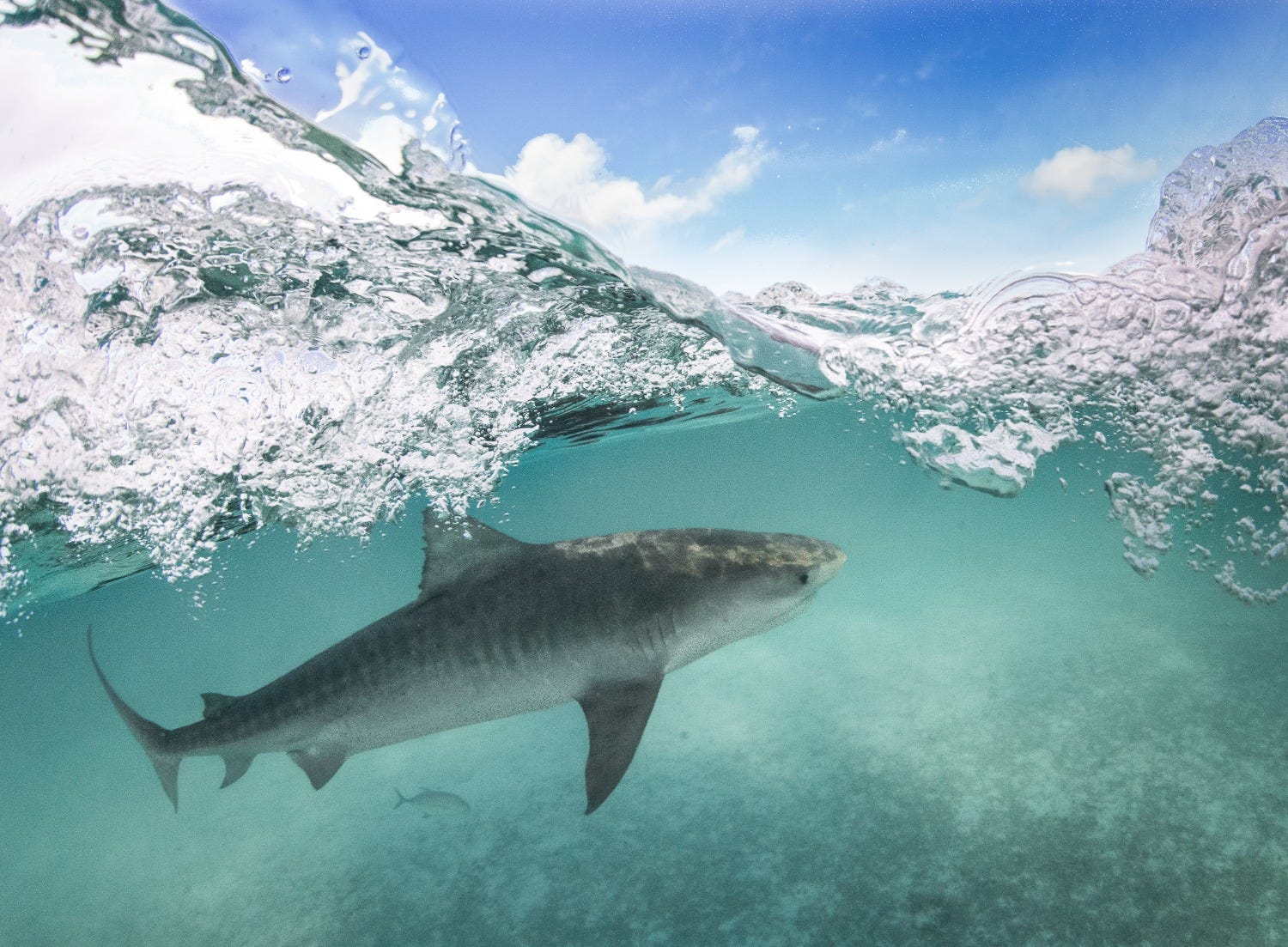
On Saturday October 17, 2015, around 10 a.m. in the morning, 44-year-old Anthony Lee took off on an ocean swim from the eastern coast of Oahu. He was with his friend Mazen Abbas, who goes by Maz. The pair planned to swim about three quarters of a mile to a couple of islands called “The Mokes,” and then back. The friends were supposed to go with a large group training for a triathlon at 8 a.m., but arrived late. They did the swim anyway. Lee was comfortable with it, having completed the route more than 30 times before.
The swimmers reached the island of Moku Nui, rested for about 15 minutes, and then swam back. They agreed to swim hard alone to get past a strong current and then to regroup in a calmer channel where the water is a little deeper—maybe 40 feet or so to the bottom. Lee reached the area first. Rain the night before had made the usually clear water cloudy. Maz was about 300 feet away, and so Lee started leisurely backstroking to let his friend catch up. Suddenly, something grabbed his legs and violently shook them. He thought his friend had arrived and grasped them. Then, searing pain shot through his body. He looked down and saw a large tiger shark biting him and thrashing around.
Immediately he tried punching the shark, which was difficult as he had turned face down and had a hard time reaching behind him. One of his legs came free, and he was able to face the shark. He put one of his hands on its nose and started punching it in the face. The predator took him deeper. Then Lee saw the shark blink. A nictitating membrane, or third eyelid, moved over its eye.
Lee ran a biotech startup called NovoKera, which has since been merged into a larger company called Longevity Biomedical. NovoKera developed biosynthetic corneas, which are placed in people’s eyes to treat corneal blindness. The company tested its devices on pig eyes. A butcher from the North Shore of Oahu provided pig heads to NovoKera for surgeries. Like sharks, pigs have nictitating membranes that help protect their corneas. After practice surgeries on the pigs, Lee’s team took the eyeballs out to check their work. Lee would often use three fingers to push the nictitating membrane back and push into the part of the eye nearest the snout to pop the organ out. Lee tried the same thing with the shark. The eyeball popped out. The predator let him go.
He floated to the surface with the eyeball in his hand and then started yelling for Maz, a gastroenterologist who had done trauma training. A foot floated to the surface beside him, and he realized it was his. He let go of the eyeball, grabbed the foot, and stuck it in his jammers, a type of tight swim trunks. Still about 3,000 feet from shore, he started backstroking and yelling for help. Soon, a man and his son showed up paddling OC1’s, sleek one-person outrigger canoes. Lee got on the bow of the father’s canoe and the son collected Maz. The father crafted makeshift tourniquets from a rashguard to slow the bleeding from Lee’s legs.
The son made it to shore first and called an ambulance. At the beach, a lifeguard put tourniquets on Lee’s legs and an ambulance picked him up. Lee focused on staying conscious, but had lost a lot of blood and passed out when the ambulance reached the emergency room. At the hospital, the foot that stayed on had to be amputated below the knee. The foot that came off was reattached through a major reconstruction. Lee spent three months in the hospital, and had nine surgeries over three years to deal with his injuries.
After his surgery, the doctor asked Lee if he wanted to keep his amputated foot. Lee said no, as the idea of the appendage floating in a jar disgusted him. The surgeon also found three shark teeth in Lee’s legs. Did Lee want to keep those? Yes, said Lee. He stored them near his bed, in a hospital billing envelope.
Lee says the father and son that rescued him saw the tiger shark that bit him, and estimated it to be 10 to 12 feet long. The longer end of that size range meets the criteria for a mature female. Though Lee knew almost nothing about sharks before the attack, he’s made it a point to learn more about them. One key thing he found is that our understanding of the predators has a lot of gaps. “It’s surprising how little we know,” he says.
Now scientists have at least partially filled in some of those gaps, with information that may offer more clues as to why Lee and several others have been bitten in October in Hawaii.
A new study by Hawaii Institute of Marine Biology shark researcher Carl Meyer finds that October shark bites in Hawaii show a significant increase over the rest of the year, despite the fact that more people aren’t in the water then. Meyer analyzed 30 years of records and found that a fifth of all bites occurred just in October—a frequency at least two times higher than any other month. Most of those bites in that month belonged to tiger sharks. Meyer has proposed a couple of reasons for the increase. He says that the spike may be due to two things. More tiger sharks are likely in the water due to an increase in adult females of the species migrating to the Main Hawaiian Islands, possibly to give birth. And after tiger shark mothers have their pups, they may be more prone to feed as they are depleted of resources due to their pregnancies.
Meyer says the big picture patterns will help people concerned about risk weigh their options about when they go in the water. Though shark bites can kill or cause serious damage, as Lee’s story illustrates, the incidents are still rare. “Yes, you have a higher probability of being bitten during October than any other time of the year in Hawaii,” says Meyer. “But it’s still an incredibly low risk, much lower than your risk of drowning or being killed in a car accident on your drive to the beach.”
Over the past 30 years, about five people a year have been bitten by sharks in Hawaii, and the vast majority of those incidents aren’t fatal. About 80 people a year have died due to drowning in the past decade. And 129 people died on Hawaii’s roads last year, a stat that includes pedestrians and drivers.
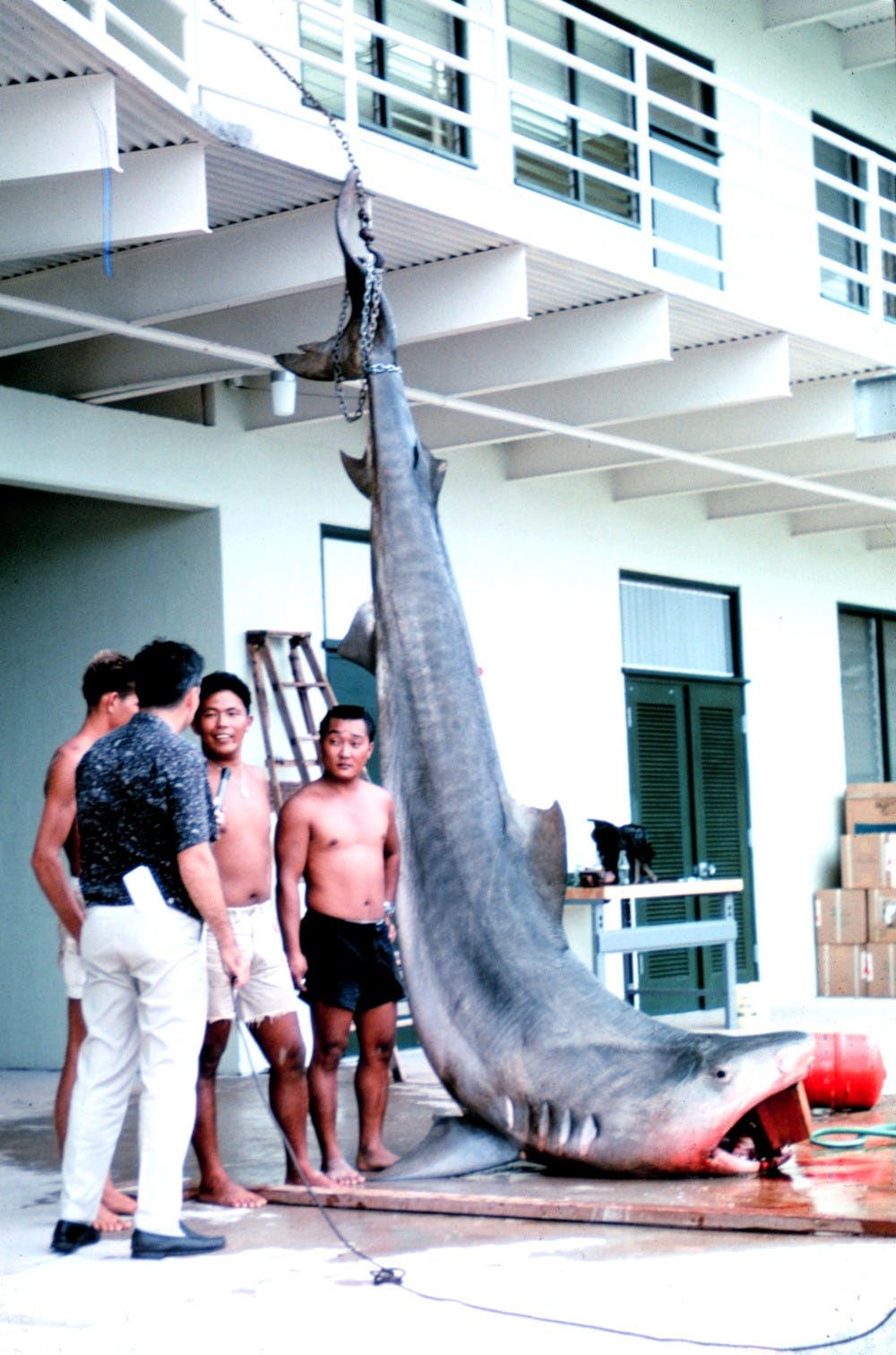
Meyer started looking into the October spike in bites over a decade ago, but needed more data to see if the signal was significant. Back in 2015, the University of Hawaii issued a press release with his initial insights. He knew then that fall was pupping season for tiger sharks and had predicted with others via a tagging study that female tiger sharks migrated to the Main Hawaiian Islands during that time, but didn’t know how much large tiger sharks increased in the area. He also knew that other species of sharks experienced shrinking livers during pregnancy, showing that they effectively starved themselves to nourish their pups. He thought this might occur in tiger sharks too, and that postpartum females may have fed more frequently to replenish their energy reserves as a result. “However, this is just an unproven hypothesis at this point,” he wrote in 2015.
But last year, Meyer had enough data to run the numbers and found the significant increase. He analyzed unprovoked shark bites from January 1995 to October 2024 and found 32 of the 165 incidents, or a 20 percent, occurred in October. More than half of all Octobers analyzed had at least one bite, compared to 6 to 10 percent for other months. October also had the highest rate of multiple bite incidents. And four of the six months with the highest shark bite counts were in October. The other two were in September and November, adding evidence to a seasonal spike.
Almost half of the total bites came from tiger sharks, and another 33 percent came from unknown species. Globally, the top three species for shark attacks are white sharks, tiger sharks, and bull sharks, in that order. While white sharks live in Hawaii they tend to be seen further offshore. Bull sharks don’t live in Hawaii. And tiger sharks often frequent the shallow areas where people recreate. “I would personally expect the vast majority of those unidentified species to be tiger sharks,” says Meyer. “But of course, they’re unidentified, so I cannot be certain about that.”
Of the 77 confirmed tiger shark bites, almost 30 percent occurred in October. And tiger sharks accounted for at least 63 percent of the October bites. So Meyer had key data showing that October experienced a significant uptick in bites, and that tiger sharks were the species most responsible. But he wanted to explain why. He came up with a theory that evolved thanks to knowledge gained over decades studying tiger sharks in Hawaii.
Meyer knew from earlier research conducted by others that the Main Hawaiian Islands were a key tiger shark pupping ground and that pups were born in the fall. He also was an author of a 2013 study that predicted movement of a high number of female sharks to the Main Hawaiian Islands around that time, potentially to give birth. Researchers tagged roughly 100 sharks over seven years and used modeling to predict that 25 percent of mature females moved from a remote atoll in Papahānaumokuākea Marine National Monument to around Oahu and other populated islands. Other categories of tiger sharks didn’t demonstrate such tendencies.
“We hadn’t looked at number of bites,” says Yannis Papastamatiou, the lead author on that 2013 study and a marine biologist with the Predator Ecology and Conservation Lab at Florida International University. “We just said that there should be more females migrating to the Main Hawaiian Islands during that period, which, if you have more sharks, it’s a numbers game.”
More sharks in the Main Hawaiian Islands, says Papastamatiou, means the likelihood of an encounter between sharks and humans increases, and so does the possibility of more bites. He started studying tiger sharks 25 years ago, and says they stand out because of their complex behaviors and broad diet. Tiger sharks in Hawaii eat seabirds, sea turtles, fishes, and even other sharks, among other things.
The predators can also alter the distribution of creatures in an ecosystem. For example, when they show up to hunt albatrosses, other sharks steer clear of the area. And they can impact the environment in ways that help fight climate change. In some places, their presence can alter the foraging of sea turtles and dugongs, which results in denser seagrass beds that may improve carbon sequestration.
Papastamatiou says that the seasonal pattern of increased bites in Hawaii adds further validation to the 2013 paper on female migration. “At that time, there was anecdotal data that there were more shark bites during October,” says Papastamatiou, “but it hadn’t ever been analyzed and quantified.”
In other work, Meyer has been studying shark ecotourism outfits that work off the North Shore of Oahu since the early 2000s. While, on average, tour operators see almost no daily tiger shark encounters from December to May, they see more than two tiger sharks a day during October, the month with the highest count.
So Meyer had all of this data and analysis coming together in time and place—shark ecotourism outfits are seeing more tiger sharks off Oahu in October, many adult female tiger sharks are likely migrating to the Main Hawaiian Islands in late summer and fall, female tiger sharks are having pups in the region in the fall, and there’s a significant spike in tiger shark bites in October. In addition, of the October tiger shark bites in Hawaii in which animal size was estimated, more than half of the sharks were as large as a sexually mature female.
“That’s an awful lot of coincidences aligning, which made me think that it was more than coincidence,” says Meyer. “It was, in fact, causality—that the reason that we had the uptick in bites, had something to do with pupping season and therefore with adult female tiger sharks.”
Tiger sharks have an unusual reproduction strategy. They are what’s called ovoviviparous. A mother’s embryos initially develop in eggs, but when the yolk is used up the young begin drinking a uterine fluid. Mothers typically carry between 30 to 50 young over 15 to 16 months, during which time an oocyte might grow from 2.5 ounces to more than three pounds. With so many young growing so fast—especially beyond the stores of their roughly racquet-ball-sized yolks—forecasting a hefty energy demand on the expectant mother doesn’t require too much imagination. “There’s probably a tipping point where the female goes into a negative energy budget,” says Meyer. “So she’s not able to intake enough calories to offset the growth of her litter.”
In sharks, the liver helps with buoyancy—working somewhat like the swim bladder of a bony fish—and stores energy. In some shark species, the liver may be more than a quarter of an animal’s body weight. Meyer knew that in other sharks a decline in liver condition has occurred as embryos develop. So he went looking for anything he could find on the liver condition of tiger sharks during pregnancy.
He found a 1950 study that recorded the liver condition of three pregnant tiger sharks from Philippine waters. One female with eggs developing in uteri had a liver weight to body weight of 26 percent. Two females with well-developed pups had lower liver weights of 21 and 20 percent. While the author, Donald E. Kauffman, noted that the data were inadequate to conclusively show the effects of pregnancy on liver weight, he also noted they may indicate the liver peaks in size early in pregnancy and decreases during gestation.
One could imagine, Meyer says, a less nimble and low energy postpartum tiger shark thanks to a liver depleted by dozens of developing young. “So it may be harder for them to catch prey,” he says. “And once they’ve given birth there may be a period where they forage more actively than at other times because they’re trying to replenish those energy stores.”
In other words, “They’re hungry,” says Meyer. “They’re hungrier than the average shark, and so that might be why we see this phenomenon.”
Meyer wishes more data existed on the livers of pregnant sharks, and thinks it was a missed opportunity that more wasn’t documented when tiger sharks were killed more frequently. But scientists wouldn’t kill sharks just to find more data now. His speculation isn’t that wild, he says, he just doesn’t have the empirical evidence yet to back it up.
“We need to be supportive of one another, as well as skeptical of one another at the same time,” says Gavin Naylor, the director of the Florida Program for Shark Research, who has studied the predators since 1986 and oversees the International Shark Attack File. “And until I see evidence that conflicts with what Carl’s suggesting, then I’m happy to view this as the current understanding of Hawaiian shark bites by tiger sharks.”
Meyer did consider other possibilities for the October increase in bites. He looked at whether sea surface temperature might line up with the uptick in some significant way, and it didn’t. He compared the number of people in the water to the uptick, and found many more people were recreating in the summer. And he hasn’t ruled out the possibility that other factors, such as an increase in prey into shallow waters, might contribute to the spike—but he has no evidence now that would support that.
Native Hawaiians have a saying, “Pua ka wiliwili, nanahu ka manō.” This translates to, “When the wiliwili tree blooms, the shark bites.” Hawaiians have noted that the tree flowers in the fall when most shark bites occur. The phrase is part of their rich oral history documenting a close relationship to nature. Meyer didn’t incorporate this saying into his paper because his early research indicated the month of October itself was at the tail end of the blooming. “I found the blooming patterns of the tree and lined them up with this October spike and they didn’t sync as closely as I had expected them to,” he says, also noting. “And the explanation could be that things have changed somehow since that particular chant was first composed, that perhaps historically those two things were more tightly aligned.”
Hawaii isn’t the only state with a temporal spike in shark bites. Naylor points out that there’s an October and November spike in shark bites off the northeast coast of Florida. But that seems to occur for two reasons. One, thousands of blacktip sharks are moving down the coast to warmer waters at that time. Two, a bunch of surfers are heading into the water to catch waves spawned by fall storms. So changes in both human and shark behavior lead to the uptick, which is different than what Meyer has suggested happens in Hawaii.
Naylor also pulled data on tiger shark bites from the International Shark Attack File. The only other place with a high density of tiger shark bites was Australia, where no apparent seasonality existed. That doesn’t mean that tiger shark bite seasonality doesn’t occur beyond Hawaii, just that the data isn’t available to see whether it happens in other places.
Meyer has been able to come up with his theories because of previous work on sharks, by him and many others, that wasn’t aimed at studying bites. Such basic science, as it’s called, has been able to document how big sharks are when they’re mature, when and where sharks pup, how their livers change, and where they travel. But Papastamatiou says much more needs to be learned about shark foraging behavior, diets, energy requirements, and even population sizes.
Researchers don’t, for example, have data on how often tiger sharks retreat from humans in the water. “That’s the other problem with sort of interpreting shark bites is it leaves out the fact that most of the time there is no interaction whatsoever,” says Papastamatiou. “A shark may approach a human, which probably happens quite a lot, and then just turns and swims away.”
Many mysteries remain about shark biology and behavior. Studies on those areas require significant funding and years, sometimes decades, of commitment by researchers. Such longterm work might seem dull and boring to the average person, but not to scientists—and their finds could lead to discoveries that offer a better forecast of when it’s safer to go in the water.
“I think the general public thinks that we know a lot more than we do,” says Naylor. “But we know very little, and I think there needs to be a lot more work on basic science because it can inform us about patterns of shark bites.”
In the future, Meyer wants to use non-invasive ultrasound technology to see whether tiger shark females are pregnant, and to possibly check the size or density of their livers.
For now, he has added another important study that helps explain our relationship with sharks. Even though the October bite uptick he’s documented is at least double that of other times of year, he reemphasizes that elevated risk is still very, very, very low. What’s important, he says, is sharing the information so individuals can make their own informed decisions.
“If you’re someone who’s concerned about it, then you can… you’re not going out there without knowing that these cycles exist,” he says. “Because it doesn’t happen very often, but when it does, I mean, the consequences are very severe.”
Each time Anthony Lee had an early revision surgery, he had to learn to walk again. Often, he tried to walk in between parallel bars with his prosthesis, while surrounded by mirrors so he could watch himself. “You just fall, and then you pick yourself up using the parallel bars. And then you fall again. You pick yourself up,” he says. “And you just keep doing that, and it sucks.”
After the first surgery, when he got to the bars, he thought, “Let’s do this.” After the second surgery, he thought, “Oh shit.” And after his third surgery, he was just dragging himself up off the ground every time. To help, his assistant made him a t-shirt, which he wore “every damn day.” The message on the front of the shirt looked like gibberish—because it was written backwards so he could see the mantra in the mirror: “I refuse to spend my life in a wheelchair.”
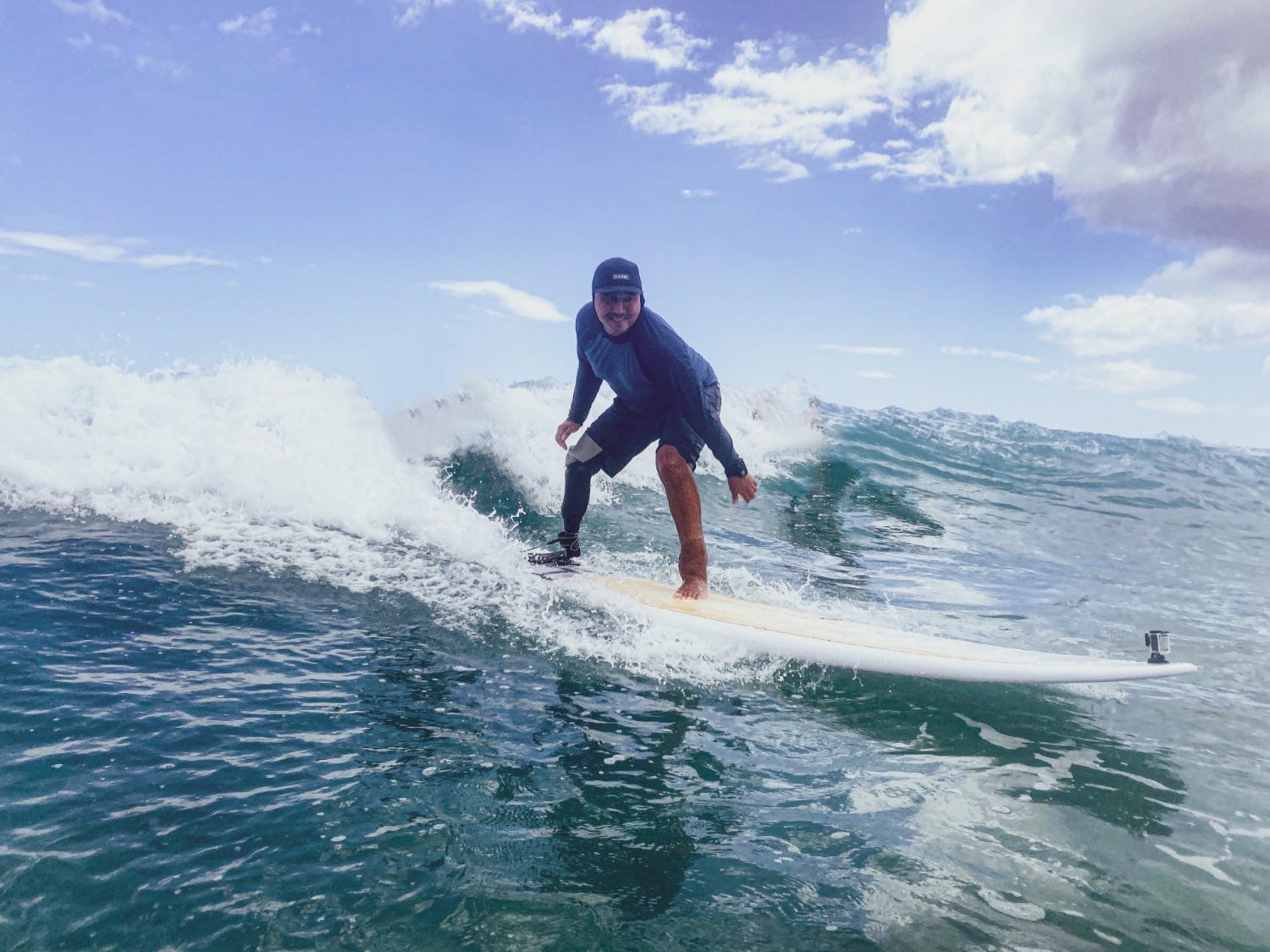
After the surgeries, Lee got involved with the Challenged Athletes Foundation and went back in the water. In 2022, he swam to “The Mokes” and back, passing the place where he was bitten by the tiger shark. Now, he often swims and surfs, but he doesn’t go out in cloudy water, and he doesn’t surf as much in October anymore. He also freedives a lot, and makes sure to pay attention to his surroundings. When he’s in the ocean and sees a shark, he always turns to face it, even if it’s not a tiger shark.
He would like to see continued funding for shark research in Hawaii, and thinks it would be wonderful if researchers could look more into the relationship between shark pupping and bites. He doesn’t think sharks are out to bite humans. Roughly nine or so years ago, he was contacted about a magnetic leash said to ward off sharks, he thinks to endorse the product, but he didn’t follow up with the company. He didn’t know whether it worked or not, but he did know the odds a bite would ever happen again were so incredibly low.
“You just got to accept a certain amount of risk in everyday life,” Lee says. “And I know, I just got unlucky that day.”
If you have any feedback, I’d love to hear about it in the comments.
And if you know anyone else who might like the Field and Lab newsletter, please share it.
Thanks for reading,
Joe
Once again your writing “ hooked” me and I read it all instead of doing housework! Great read and example of scientific method!
The dust bunnies are on you!