


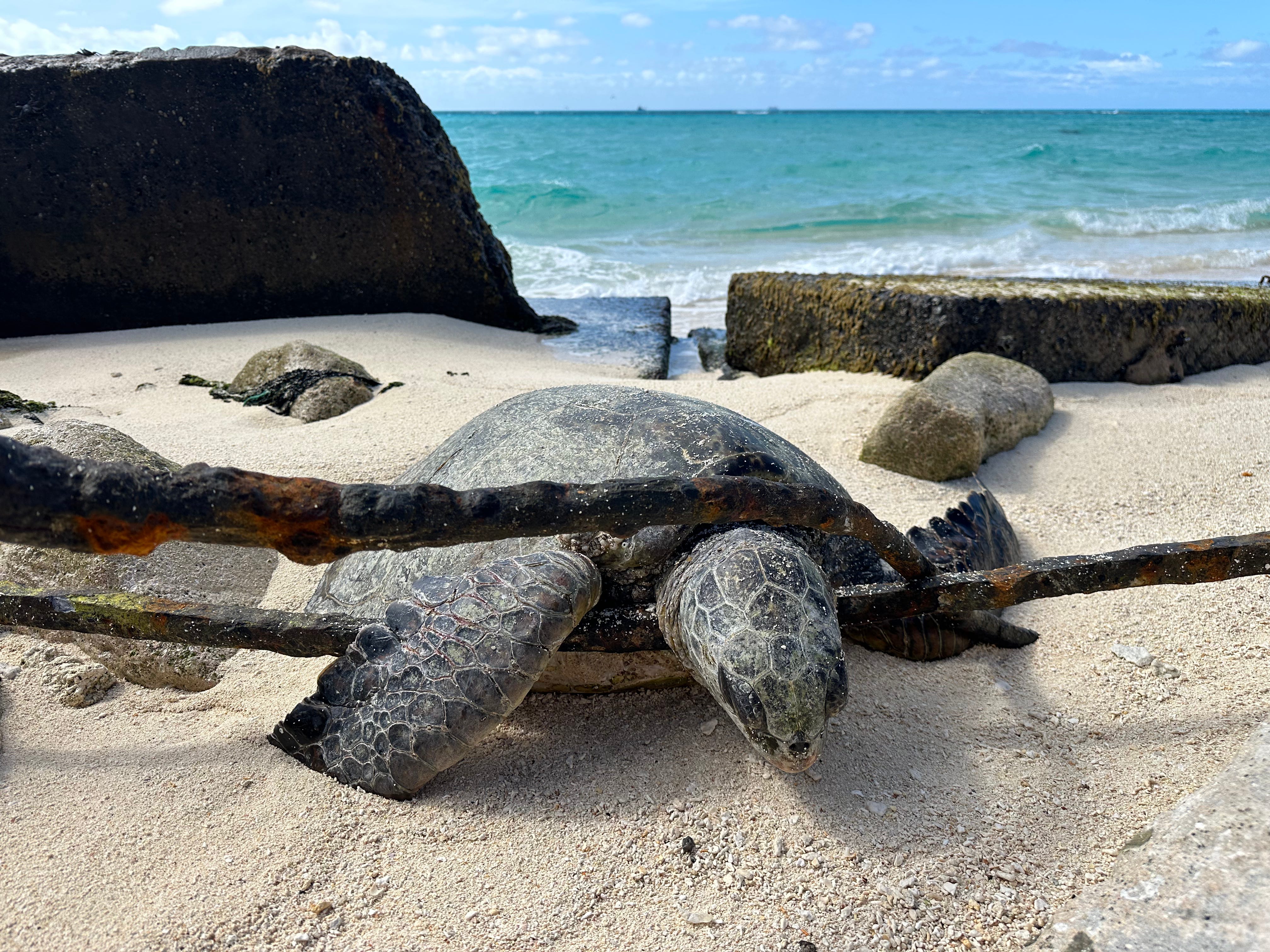
In this 2014 footage gathered by the author, a nesting Hawaiian green sea turtle is wedged in the sea wall at Tern Island after trying to crawl back to the ocean. She was assessed for injuries, freed, and guided to the surf, where she swam away. A board was put up to prevent future entrapments in this spot. Some temporary and permanent changes have been made to the decaying structures on Tern Island, but new ones emerge constantly. Joe Spring / NOAA
More than 1,100 times this nesting season, adult Hawaiian green sea turtles had to be rescued from or guided away from pits and holes and cliffs on Tern Island. The former remote military outpost has become the prime nesting beach for the species, an alarming situation as the place is becoming ever more dangerous as its manmade buildings and structures fall apart and create deadly hazards.
This year, teams of researchers had to often put aside their scientific duties to make sure vulnerable sea turtle mothers did not get trapped and die. Unfortunately, in August those researchers had to abandon their duties due to Hurricane Lala, leaving dozens of expectant mothers each night on their own on the island. That’s to say nothing of the thousands of emerging hatchlings who would not have human hands to pick them up and bring them over manmade obstacles to the ocean.
For more than a decade now, scientists have spent their days and nights on this remote outpost in Papahānaumokuākea Marine National Monument rescuing trapped Hawaiian green sea turtles. For several field seasons I was one of the researchers. But recently the conditions have gotten much, much worse.
I learned a lot about the disturbing number of rescues this year after reporting a story for Sierra magazine on the overall recovery of Hawaiian green sea turtles, which have rebounded dramatically over the past half century. The honu, as the creatures are called in Hawaiian, have gone from being rarely seen by people in the Main Hawaiian Islands in the 1970s, to being regularly spotted all over the place. Snorkelers see them feeding on algae. Tourists see them basking, or resting, on beaches. And beachfront homeowners sometimes wake up to find mothers have laid a nest in front of their property.
But not all the news is good news concerning the turtles. The honu’s main nesting beach was East Island, a dot of land roughly 500 miles from Honolulu. Nesting turtle numbers there went up from 67 in 1973 to more than 800 in 2014, thanks to protections. But in 2018 a hurricane nearly wiped East Island off the map. Though it has recovered somewhat, and had more than 600 nesters this year, most of the turtle nesting moved from East to nearby Tern, which is rife with dangers. This year, 847 female turtles were documented digging on Tern.
I wrote about Tern and its deadly issues in 2023 for Smithsonian magazine. Back then, dozens of turtles were trapped each season in an aging seawall or decaying infrastructure. And one year, seven of them died. Unfortunately, the number of trapped turtles has gone up dramatically.
In 2024, nesting turtles had to be helped more than 300 times. This year, based on preliminary data, researchers had to make more than 1,100 interventions during morning surveys. Three of those interventions were males, and the rest were nesting females. Researchers placed their rescues into two categories. True entrapments, of which there were 47, indicated situations where the turtle had no chance of freedom and would die without immediate human help. The remaining cases were potential entrapments, or situations where researchers had to guide turtles away from a trap or imminent danger, like a cliff.
Almost 600 adult nesting females had to be helped at least one time, and 248 had to be helped multiple times. One turtle, T 149, had to be helped 12 times as she attempted to lay her eggs on the island.
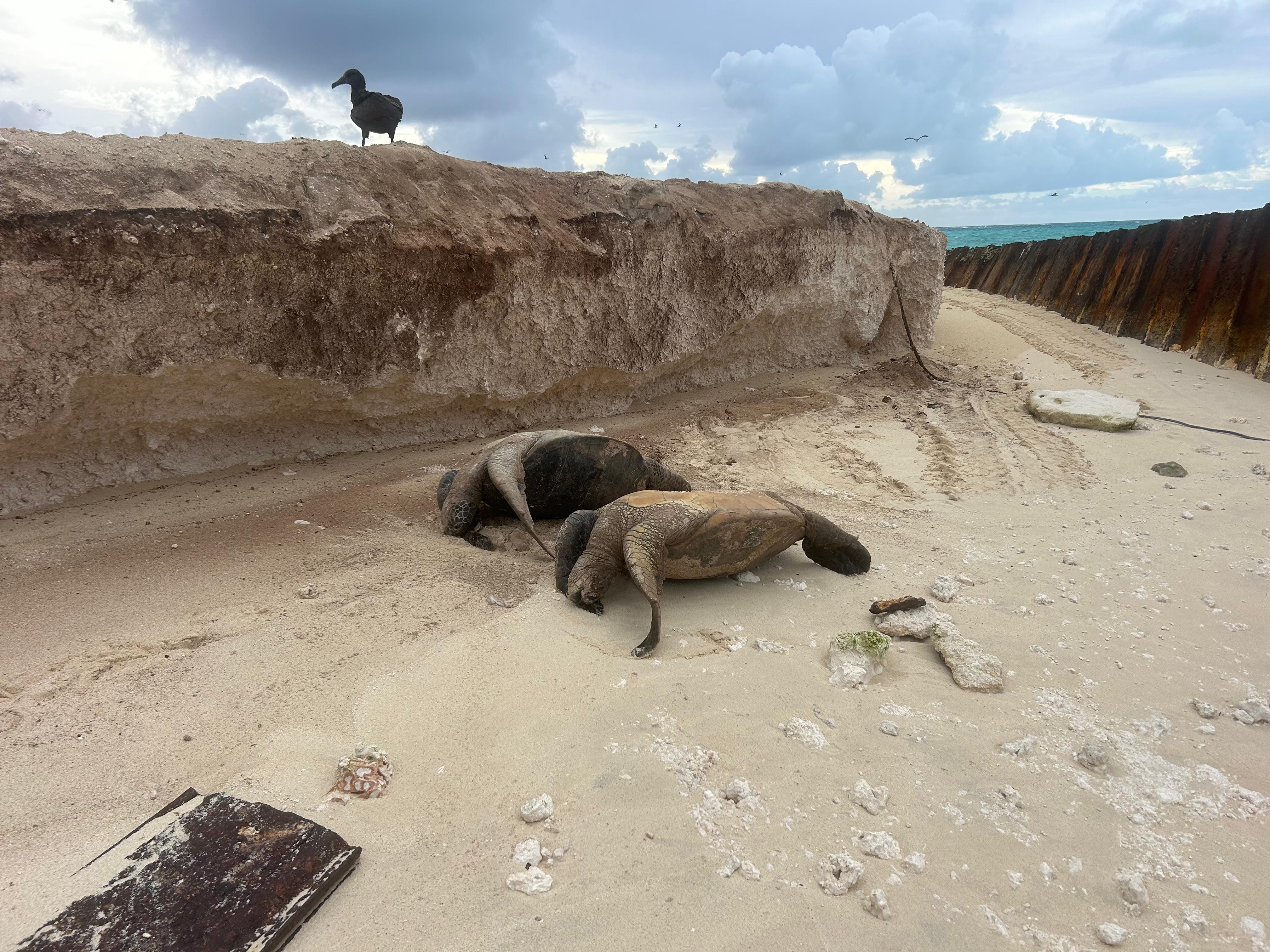
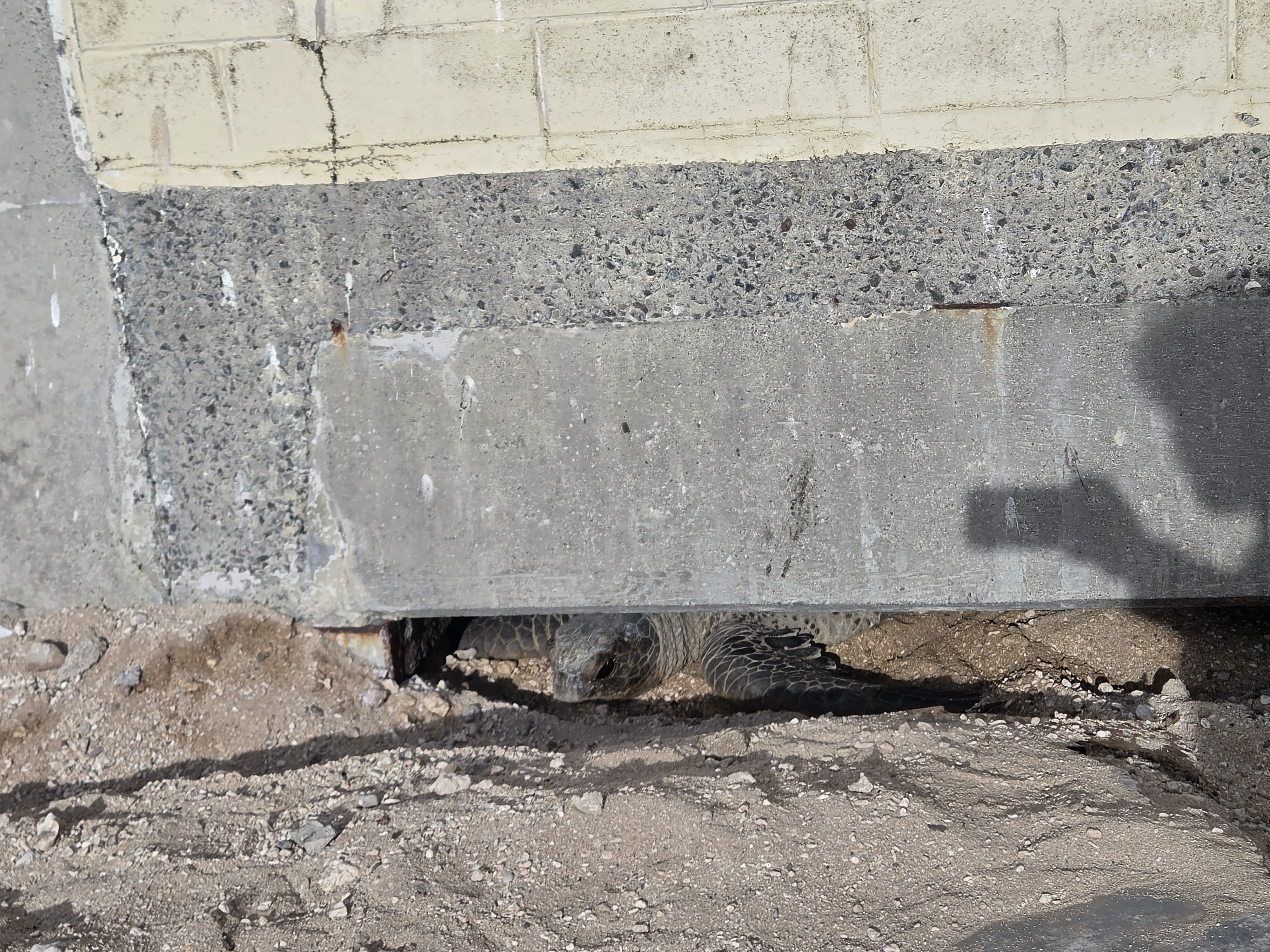
The nesting turtles get trapped in many ways on Tern. They get wedged in the holes and cracks of the damaged and rusting seawall that rims the island. They flail their flippers, unable to move forward. They crawl into large cracks of concrete and into holes under degrading buildings and are unable to get out. They haul themselves up sandy portions of beach and then try to get back to the water at other parts of the island, where cliffs created next to washed out seawalls leave them to drop onto the beach below. When they fall headfirst to the ground, they can seriously injure their flippers, necks, and heads. My former boss, George Balazs, who first went out to Tern in the 1970s, now calls it a turtle “death trap.”
In this 2014 footage collected by the author, a nesting Hawaiian green sea turtle struggles on her back. She had crawled a great distance along a seawall before coming to a spot where she could see the ocean, but the beach was a few feet below her. She crawled headfirst off the ledge and damaged her right front flipper when she fell. She was assessed for injuries and carefully flipped over. Right after this, she crawled into the ocean and swam away. Joe Spring / NOAA
This year, teams of four to six people would walk around the island each morning, sometimes helping 20 to 30 nesting females a survey. At times scientists had to work together using straps and other devices to free expectant mothers wedged between cracks in metal seawalls.
“We did have a lot of check-ins about the welfare of our staff, and are they being safe,” says National Oceanic and Atmospheric Administration scientist Marylou Staman, who has herself worked to save turtles that may weigh more than 200 pounds. “Is everyone feeling comfortable? How are your backs? Is this becoming too much?”
The more than 1,100 interventions counted were only those documented in the morning. The staff also had to aid several turtles each night. To help block sea turtles from getting to some parts of the island, researchers also put up some temporary fencing.
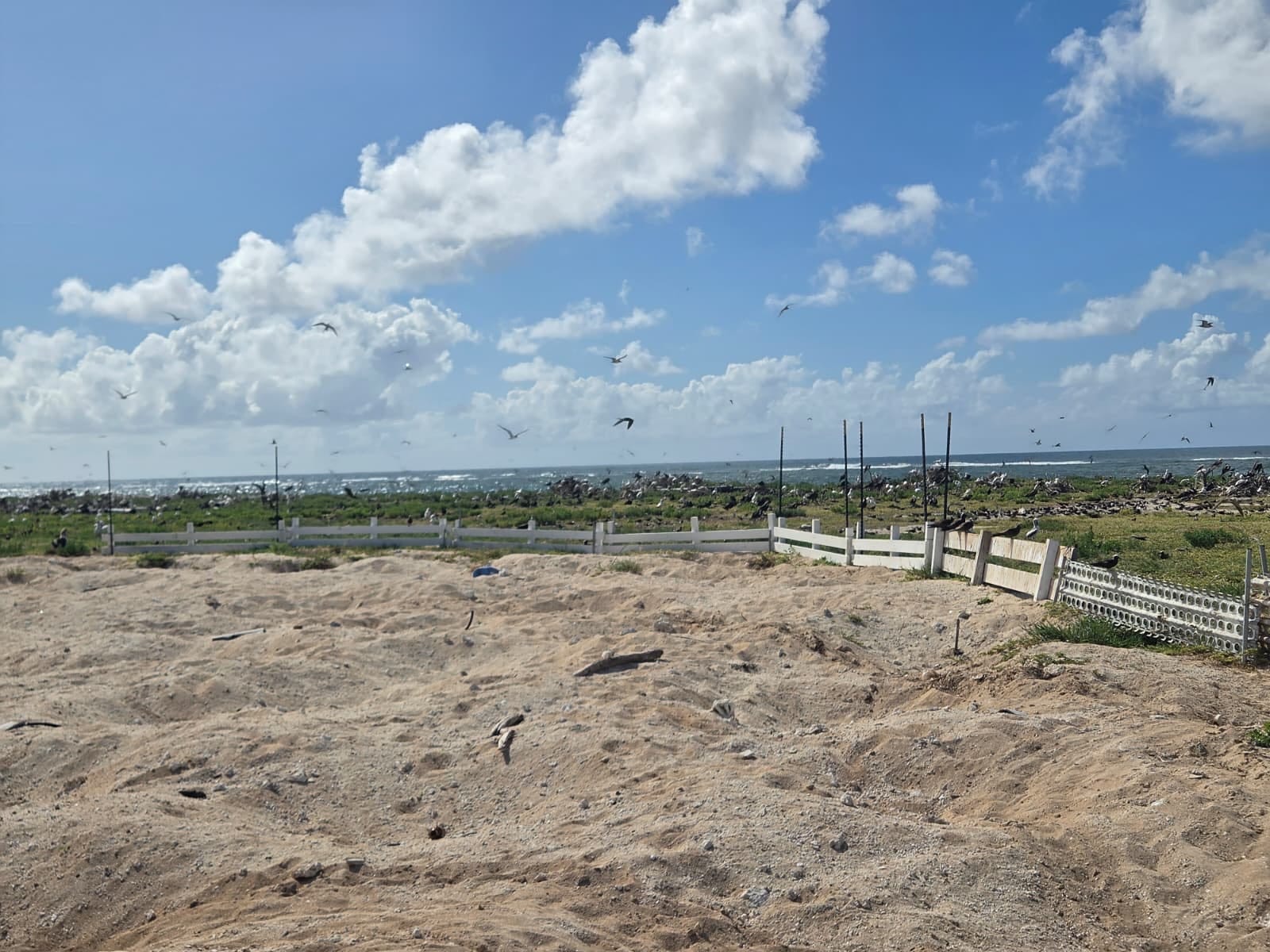
For the turtles, a nesting night on its own is taxing. Many have swum hundreds of miles from up and down the archipelago to come ashore to nest on the islands of Lalo, the coral atoll where Tern is located. To get to Lalo, they have to evade hungry tiger sharks and derelict fishing nets that could entangle them. On Tern, they spend their nights crawling over the land and digging pits in which to lay their eggs, an arduous task. But that task is now marked by a gauntlet of increasing man-made hazards. And this August, roughly 50 mother turtles a night were still coming up to nest when researchers fled Tern before Hurricane Lala, causing concerns among the scientists that animals have since gotten trapped and died.
“So you’re not just talking about mortality of females,” says Staman, “but all of these nests were laid behind these sea walls and then what happens?”
Young hatchlings, which crawl over the beach toward the ocean by the thousands, may hit the seawall that rims the outside of the island and find their path blocked. Many will crawl back to the interior of the island, where they may wander until they die. Or they may scamper into holes and cracks and be unable to climb out.
“I don’t want to say that it’s 100 percent blockage because hatchlings are crazy in the way they tumble and find pockets to get through,” says Staman. “but it’s very few places where a hatchling would pop out of its nest and just have a free path to the sea.”
When researchers are on Tern, they help the youngsters, but now many of this year’s hatchlings are on their own.
This 2014 footage collected by the author shows a sea turtle hatchling crawling beneath the seawall in a dark area. When hatchlings hit the seawall, they often turnaround and crawl back inland towards the old runway of the island. They can crawl for days over this large expanse and die if they are not rescued. After a rain, the old crushed coral runway can turn into a paste that acts like quicksand to the hatchlings. All the hatchlings in this video were picked up and released into the ocean, where they swam away. Joe Spring / NOAA
For centuries, Tern Island used to be a gently sloping dot of land with soft sand. In the 1940s, the Navy turned the island into a half-mile-long crushed coral runway for planes to land on in between Oahu and Midway Atoll. The Navy and then Coast Guard used the island until 1979, when it was handed over to the U.S. Fish and Wildlife Service to be a field station. Scientists stayed their year-round until a storm in 2012 damaged their living quarters. Now researchers just stay there over an extended field season in the late spring and summer months. When the researchers leave Tern, nobody is there to watch out for the sea turtles, Hawaiian monk seals, and seabirds that could die in the island’s hazards.
If a year comes when the environmental agencies that help oversee the place, NOAA and the USFWS, either don’t have enough funding to do their summer field camps or can’t venture out there otherwise, many more turtles could die. And additional storms in the future, like Lala this year, could force scientists to evacuate the island, leaving turtles on their own once again.
To completely fix Tern will likely take tens of millions of dollars, and possibly cooperation between military agencies like the Navy and Coast Guard and research agencies like the USFWS and NOAA and Environmental Protection Agency, with possible assistance from nonprofits. The environmental nonprofit the Papahānaumokuākea Marine Debris Project (PMDP) already did one mission to the island to clean up damaged building materials and trash scattered around it.
And that organization recently sent some very good news regarding the island as I was writing this.
“I’m thrilled to announce that PMDP has just been awarded $8.5M from NOAA Fisheries Office of Habitat Conservation for a coastal habitat restoration project at Lalo,” wrote Kevin O’Brien, the organization’s president, in an email this past Friday. “Over the next three years, we’ll be embarking on an ambitious project to restore the heavily-impacted coastal habitat at Tern Island, Lalo, through the removal of the condemned and deteriorating buildings and infrastructure, enhancement of existing coastal habitats, and vegetative restoration.”
PMDP will continue to fulfill its core mission, cleaning up ghost gear from the monument, and will work on Tern Island in close collaboration with NOAA and the USFWS.
Such a project may not be able to restore Tern completely to its former state, but will certainly be a massive step to improving conditions for sea turtles, endangered Hawaiian monk seals, and the many species of seabirds that nest on the island.
As far as the Hawaiian green sea turtles go, throughout the past half century many steps have been taken by people to protect the species. But now—in their most important rookery—turtles face deadly manmade obstacles that threaten a full recovery. And so, until Tern Island is completely fixed, the story of the resurgence of the Hawaiian green sea turtle comes with a big question.
“Is this population human intervention dependent?” says Staman. “Are they gonna only survive nesting on Tern Island if we have people on the ground keeping them out of these hazards and removing some of these hazards?”
To learn more about Tern Island, read my 2023 feature in Smithsonian magazine. To learn more about the honu recovery, read my 2026 feature in Sierra magazine.
Thanks for reading,
Joe