

Surfing Lake Superior
Checking in with the instructor teaching students how to ride Minnesota's frigid fall and winter waves

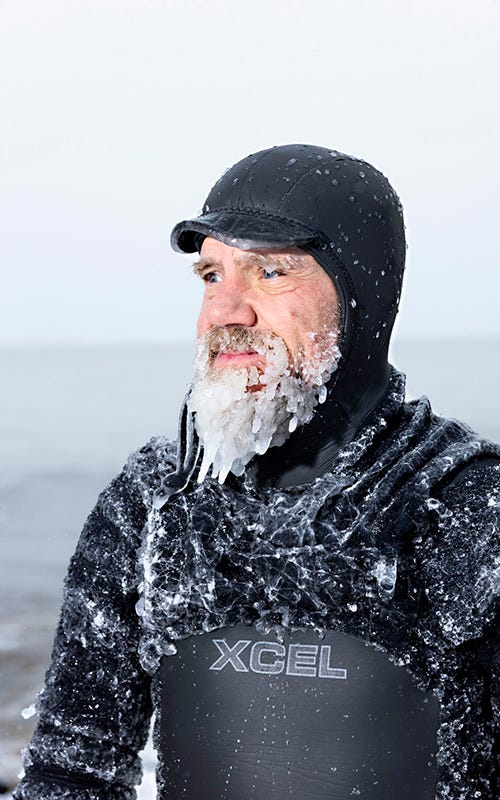
Randy Carlson first started surfing Lake Superior’s waves in 1988, and by 1990 he was teaching students at the University of Minnesota Duluth to do the same. Carlson has worked in the school’s Recreational Sports Outdoor Program since he was a student in 1983, and later took a job there leading some adventure sports classes and excursions full time. Surfing Lake Superior is not for the weak, as the best waves often come in fall and winter, when the water can easily drop to a chilly 32.1 degrees, and the air is even colder. When the water hits such temps, surfers may find themselves riding through slush pancakes on the lake’s surface.
More and more such surfers are riding in those conditions, thanks in part to Carlson’s guidance. Since the 1990s, he’s seen the line-up grow from roughly a dozen surfers from Duluth and some from the Twin Cities, to maybe 100 from Duluth and another 100 from the Cities. While most of those surfers are wearing similar wetsuits in the water, Carlson says it’s possible to identify different individuals by their surfing style.
I wrote about the 60-year-old Carlson’s dedication to teaching students how to surf the lake for Minnesota Conservation Volunteer magazine’s latest issue. That interview mostly focused on his connection to the students, and what they learn in his program, which meant I had to cut a few choice answers from him about what it’s like to surf in Minnesota in the winter, and his most memorable waves. I’ve included those parts of the interview below, as I think they highlight Carlson’s connection to the winter sport and to the lake.
So for someone that hasn’t been in Lake Superior in the winter, can you just talk about what it’s like surfing in December, January, or even February?
Boy, it’s the most rewarding time of year, from my perspective. The contrast between the snow and the water is part of what I enjoy. To do a water sport while it’s snowing just doesn’t seem normal, but the wetsuits are so good that we’re warm. And the water is really clear in the winter. I don’t like to get cold, so I put my wetsuit on at home, and I put hot water in the booties and mitts. For the winter surfing you can learn how to stay warm. If I start getting cold, I’ll switch from prone surfing, where your feet are kind of stuck underwater, to stand up paddleboard surfing. And so now my feet are on top of the board and my hands are using the paddle. I guess one of the characteristics I’ve developed is the combination of prone surf and stand-up paddleboard surf to last for 6 to 8 hours in the water.
What does that feel like on your face?
Well, you get your heart pumping and so the heat from your core is kind of pushing out your face. It’s the only spot that doesn’t have neoprene on it. So your face gets cold, but not as cold as what you would think, even if you have ice on your head. You have to have the right nutrition, eating well before you go because at some point these storms will last two, three days. And if by the time you’re into your second or third day you’ve tapped your glycogen reserves, then your furnace isn’t running as efficient.
Do you have a memorable moment of getting your best ride? Is there any one wave you remember the most?
There’s been waves at Stoney Point or up the shore that are double overhead. You never forget the really big waves that you were able to catch. And then sometimes it’s a little bit too scary, and you let it go, and wish you hadn’t let it go. Because you’re like, “Oh, I should have gone on that one.” But maybe you’re just a little too frightened. So, I don’t know. It’s like fishing, the big one that got away. Those haunt you, and you vow to not let too many others get away.
If you want to read more about Carlson and his efforts to teach others how to surf in Lake Superior, please check out my interview with him in the latest issue of Minnesota Conservation Volunteer magazine.
If you have any feedback, I’d love to hear about it in the comments.
And if you know anyone else who might like the Field and Lab newsletter, please share it.
Thanks,
Joe