


Usually, when I’m chatting with one of my siblings by phone, later in the call we ask each other what good movies we’ve seen lately. I tend toward watching documentaries, and many of those are science and nature flicks or limited series—so at times that’s what I recommend. Recently, I made a list of The Best Science and Nature Books of the 21st Century, and had a good response on here. So I decided to do the same thing for documentaries. I wrote down the best science and nature flicks I watched from 2000 to 2024, and then whittled the list down to my favorites. Leaving out some films—Virunga, Mission Blue, Wildcat—was difficult, but occurred partly because I included not just standalone films, but also high-quality limited series with awe-inspiring footage. As much as I wrote this dispatch to share what I’ve enjoyed, my reasons for making the list are also selfish. I’m hoping you’ll weigh in on the list in the comments with suggestions of other films or limited series you think deserve inclusion. Disagreements aren’t only welcomed, they’re encouraged. Have a look below and tell me what you think.
The Cove
One of the most suspenseful movies on this list, in The Cove director Louie Psihoyos sets out to document the capture and slaughter of dolphins near Taiji, Japan. The watcher tags along as Psihoyos and his crew work to get footage of fishermen catching and killing the dolphins. As that drama unfolds, other subjects fill in the details on whether such efforts against the marine mammals should take place. One of the more powerful characters that addresses that topic is Richard O’Barry, a trainer who helped make Flipper a television star, and now does everything he can to make sure dolphins live freely in the wild.
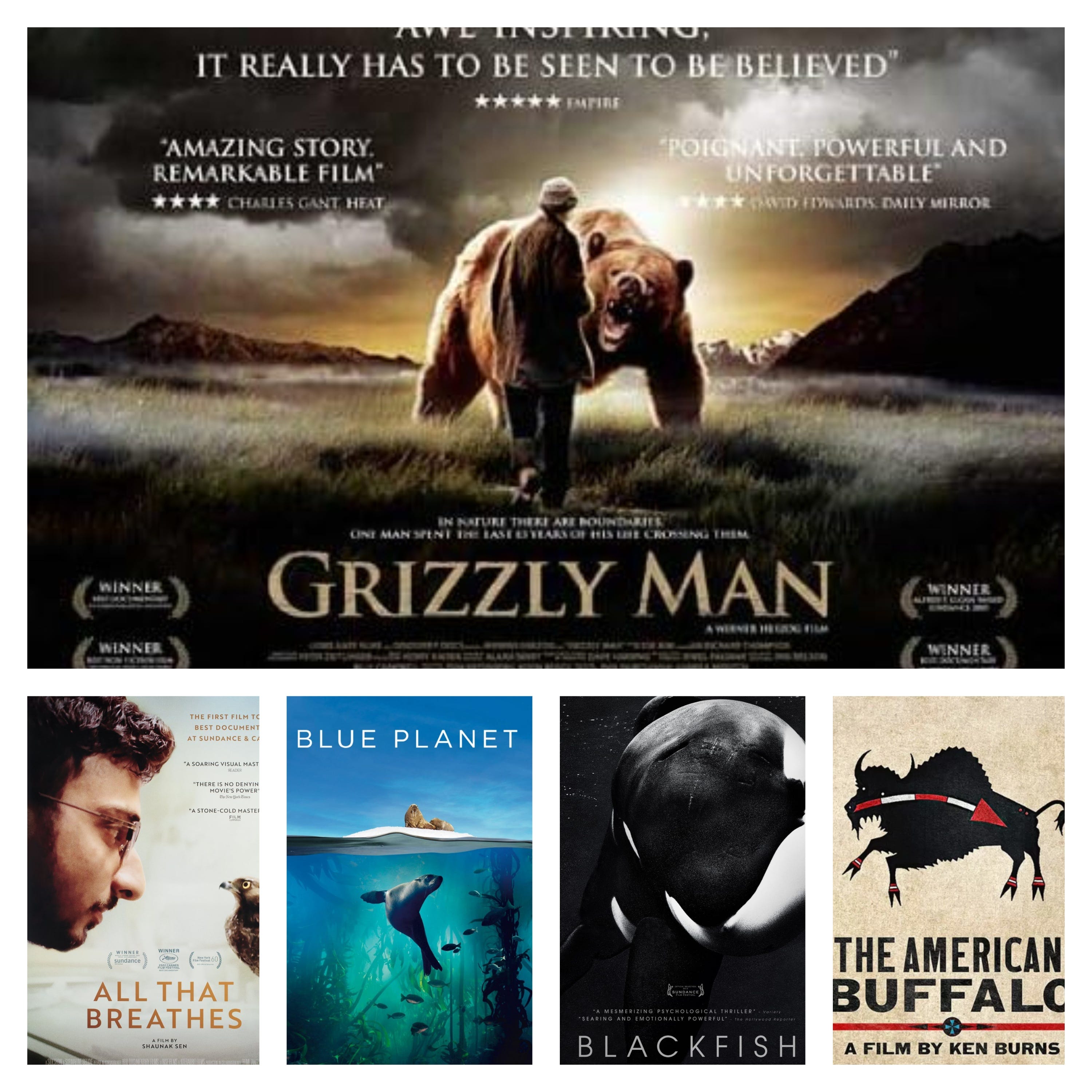
All That Breathes
This documentary about two brothers and a helper who care for injured black kites in India moves at a slow and steady pace that draws you deeper and deeper in. I remember first watching it and being struck by how creatively scenes were shot. The scavenging birds end up in the rehabilitators care after trying to make an existence in New Delhi’s dumps and streets. The watcher becomes consumed by the rehabilitators’ struggles to feed and help all the injured animals—in a vérité film that flows more smoothly than you expect from a nature documentary.
Grizzly Man
Werner Herzog’s documentary about a man attacked and killed by a grizzly bear seems unbelievable. Timothy Treadwell decided to live among the bears in Alaska and film himself, acting as a sort of amateur naturalist guide. Treadwell’s death is jarring, but this movie succeeds not just because of the main character’s story and footage, but because of all the different angles Herzog examined while making the movie.
Blackfish
When I was at Outside, journalist Tim Zimmermann wrote two eye-opening features for the publication about the alarming treatment of captive orcas. The stories documented the impacts of the confinement on the animals, and, ultimately, the trainers, some of whom the orcas killed. Zimmermann would go on to co-write and associate produce Blackfish, the documentary that exposed how the charismatic marine mammals, which would normally swim over thousands of miles of ocean, suffered while confined. The movie changed many people’s views about capturing and keeping the animals in parks for entertainment, and put pressure on that industry to stop.
An Inconvenient Truth
The premise sounds a little boring—a documentary built around a politician’s lecture on climate change. But Davis Guggenheim’s film about former vice president Al Gore’s effort to raise awareness about global warming was both entertaining and impactful when it came out in 2006. At the time, Gore was frustrated about his inability to awaken the public to the issue, and the film captures that. As temperatures continue to set records almost two decades later, Gore is still fighting to raise awareness about climate change.
Blue Planet and Blue Planet II
When making this list, I hesitated about whether to include series or not. In the end, I decided to because some series captured some of the most amazing feats in nature. The first series on my list was Blue Planet and the following Blue Planet II. Science writer Ed Yong called the second installment the greatest nature series ever produced by the BBC. The episodes feature narration by David Attenborough, lessons about our impact on the oceans, and awe-inspiring footage—of an octopus battling a shark, breaching humpbacks, and jacks jumping out of the ocean to eat seabirds.
My Octopus Teacher
This Oscar-winning documentary that came out during the Covid pandemic captures the interactions between a diver and a lone octopus. South African filmmaker Craig Foster free dove frequently off the coast outside Cape Town to check in on a cephalopod. Foster captured much of the footage, but directors James Reed and Pippa Ehrlich crafted the film into a moving piece about the value of connecting over and over again with a single wild creature.
Fire of Love
The deepest human love story on this list is Fire of Love, a documentary about a pair of French volcanologists. Geologist Maurice Krafft and geochemist Katia Krafft are bound by their affection for each other and exploding mountains. They traverse the Earth—filming as they go—studying and recording some of the planet’s most volatile volcanoes. Their historical footage is mesmerizing and illustrates the danger the couple would put themselves in so they could learn as much as possible about molten rock, ultimately to their demise.
Sea of Shadows
This film breathtakingly chronicles the efforts of scientists, conservationists, undercover agents, and others to save the vaquita, one of the most endangered marine mammals on Earth. The environmental thriller won the Audience Award at Sundance for its ability to show how global forces are disastrously impacting a dwindling population of porpoises in the Sea of Cortez.
Planet Earth and Planet Earth II
You probably distinctly remember one of this show’s most iconic scenes, of young marine iguanas running away from a gauntlet of hungry snakes? That appeared in the second season of the series, along with other rich footage of a sloth, Komodo dragons, peregrine falcons, and more. But Planet Earth II also documents humans’ impact on the environment, such as when it shows how artificial light draws hatchling sea turtles away from the ocean and into danger. (The animals were collected after the footage was captured and taken back to the sea.)
Jane
What was life like for a wildlife researcher in Africa in the mid-20th century? This documentary about now iconic primatologist Jane Goodall, directed by Brett Morgen, offers an intimate look—thanks to a lot of historical footage. Anyone who is a fan of Goodall’s recent conservation work will be engrossed with her early groundbreaking experiences in the field.
If a Tree Falls
This film tells the story of the Earth Liberation Front, a group which set fire to properties owned by outfits ranging from a ski resort to timber companies. Much of the documentary focuses on member Daniel McGowan, but it also features interviews with other group members and the officials chasing them. In so doing, it may spur the watcher to ask a key question. How should we think about environmental groups that cause destruction worth millions of dollars?
Chasing Ice
With a band of young adventurers often at his side, environmental photographer James Balog set out to document how glaciers were changing by setting up remote cameras. Over the course of years, his efforts would reveal major losses of ice at the edges of the world. This film, directed by Jeff Orlowski, documents Balog’s quest—and reveals obstacle after obstacle the photographer must overcome to bring home his desired footage.
Our Planet and Our Planet II
Along with jaw-dropping visuals, Netflix’s Our Planet does more than similar series to highlight humans’ impact on the Earth. Disturbing images of calving glaciers, bleached coral, and struggling polar bears show up, just as do awe-inspiring shots of fledging albatross, hunting lions, and migrating red crabs. The result is a fuller show than similar series about the Earth and its many mesmerizing creatures.
The Territory
As farmers and other settlers move into the Brazilian Amazon, the Indigenous Uru-eu-wau-wau both fight against the encroachment and record what is happening. Their battle has implications for their own survival, and the surrounding environment they depend on. Director Alex Pritz uses the group’s footage to take the watcher into their community as outside forces intrude.
Encounters at the End of the World
What type of person would commit to live and work at Antarctica’s famous McMurdo Station? Herzog shares the stories of several of them while showing stunning vistas from a place like nowhere else on Earth, creating an entrancing film.
Path of the Panther
Director Eric Bendick’s film follows National Geographic photographer Carlton Ward’s efforts to document the plight of the Florida panther, while also showing the dedicated group of experts trying to save the predator. The film is part of a larger effort to inspire the conservation of the Florida Wildlife Corridor—a series of connected lands the big cat and other creatures need to survive in the state. Watchers will get drawn into Ward’s efforts while learning important environmental lessons in the process.
The American Buffalo
Ken Burns has made in-depth documentaries about a host of American subjects. The American Buffalo, which chronicles our relationship with the iconic animal, is my favorite. The two-part, four-hour PBS movie documents the evolution of the animal, the connection of Indigenous people to the creature, the Buffalo’s demise, and the attempts to bring the mammal back from the brink. The most powerful moments in the film document the near complete slaughter of the creature, and later the willingness of the Indigenous subjects interviewed to continue to share the Buffalo with others.
Winged Migration
I wavered a bit about whether to put this one on the list, partially because some of the footage was filmed of birds trained to follow humans. I added it because it has a ton of jaw-dropping natural footage that shows the diversity of birds around the world. The sheer effort involve in capturing the film’s sweeping images was collected over three years by more than 450 people. The resulting film is short on narration, but long on engaging scenes documenting what life is like for a bird.
Gasland
After Josh Fox received a letter from a gas company offering to lease his family’s land for drilling, he set off on a trip to see how fracking was affecting others around the country. The writer and director crafted Gasland to share what he learned. The movie was nominated for an Academy Award, and set off a series of accusations back and forth between the industry and Fox—ultimately leading to more conversations analyzing the potential pros and cons of the extractive industry.
Chasing Coral
Why are so many coral reefs around the world suffering? This film highlights a group of divers, scientists, and photographers looking for answers as they document what is happening. Fans of Chasing Ice, which was also directed by Jeff Orlowski, will enjoy this feature focusing on one of our planet’s most dynamic ocean ecosystems.
March of the Penguins
If I was asked to name the most famous nature documentary of the 21st Century, I would probably guess this movie about Antarctica’s emperor penguins. The flick won the 2006 Academy Award for Best Documentary Feature, and was memorably narrated in the United States by Morgan Freeman. While the movie caught some flak for anthropomorphizing the birds, it features rare and stunning footage of the southern extremes the penguins endure.
Our Oceans
The scenes of orcas hunting seals resting on floating ice are reason enough to watch this five-part Netflix series narrated by Barack Obama. Each episode documents a different ocean, and the viewer gets to see amazing footage of a variety of creatures, from coral reefs to sperm whales to mantis shrimp. Netflix even offered a guide outlining each episode, and listing the on-camera firsts that appear within them.
Earth at Night in Color
While a lot of previous footage of nocturnal animals appeared in black and white, new camera technologies allow for creatures to be filmed in color. Apple’s Earth at Night in Color chronicles the moves of lions, monkeys, elephants, seals, and bears under the cover of darkness. The two seasons of the show offer a spectacular glimpse into what happens in the world around us as we sleep.
The Salt of the Earth
This film profiles the career of Sebastian Salgado, a globe-trotting photographer who captured iconic images of human conflict and our impact on the Earth. Though the movie covers a wide array of subjects, it fittingly ends at Salgado’s home, with a memorable point about the possibility of restoring nature.
What about you? What’s your favorite science and nature documentary of the last 25 years?
And if you know anyone else who might like the Field and Lab newsletter, please share it.
Thanks for reading,
Joe
I also loved My Octopus Teacher. The octopus wrangler at the MBAQ told me that she often held hands with the octopus under her care: she said that it calmed her and the octopus seemed to enjoy it too! Alas, I rarely have time to watch tv or movies...don't know what keeps me from it. But taknks for the list: I will keep them in mind!
I was a huge fan of My Octopus Teacher. Loved the relationship he built with the octopus.