


Part of my job as a freelance science journalist includes looking for stories in obscure scientific journals. The titles of the articles are sometimes clunky, or full of jargon, and the opposite of the click-inducing headlines you come across on news sites and social media. So when scanning them, I have to pay attention, and not let my mind drift. Focusing can sometimes lead to a question, and then, a story.
That happened when I was reviewing a recent issue of the journal Wilderness & Environmental Medicine. I ran across the title “Simulated Avalanche vs Tree-Well Burial Effects on Human Physiology.” Which immediately made me wonder, “How did they ‘simulate’ such dreadful, often fatal, conditions?”
I’m not a skier, but I know from my time as an editor at Outside, both avalanche burials and tree well burials are horrific ways to die in the snow.
In an avalanche, massive amounts of snow release from a mountain slope and slide downhill. The racing sheet can reach speeds of 100 miles per hour or more and pick up soil, ice, vegetation, and rocks as it rushes downhill. A medium size avalanche, of say 100 tons, can kill a person. An extreme avalanche, of say 100,000 tons, can destroy a village or tract of forest. On average, about 40 people a year die of avalanches in North America.
When someone—a skier, a snowmobiler, a hiker, a snowboarder, a snowshoer, a climber—dies in an avalanche, it is most often not from the trauma. A November 2025 study in the scientific journal Resuscitation Plus, found that asphyxia was the leading cause of death, representing 72 percent of fatalities. When a victim is buried, they die due to a loss of oxygen, possibly from snow blocking their airway or from pockets of space around their faces becoming dominated by carbon dioxide. Trauma related deaths—including head, neck, or chest injuries—represented 18 percent of fatalities. Hypothermia alone represented about 1.5 percent of deaths. When it comes to asphyxia, about two-thirds of victims die from the condition in the first 35 minutes, one 2024 study hypothesized.
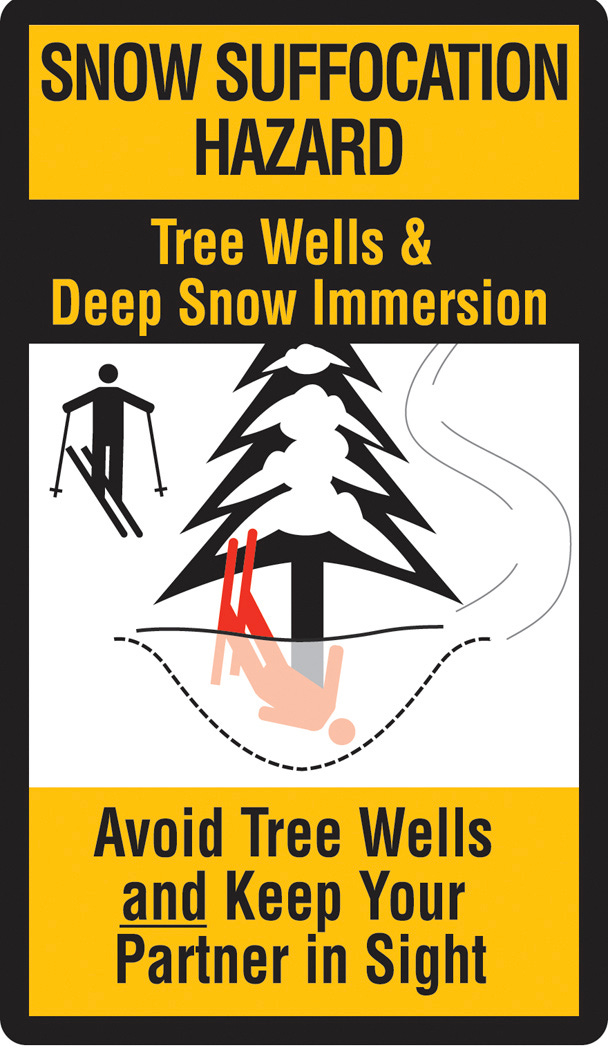
A tree well burial is also a traumatic way to die. Tree wells often occur around conifer trees when it snows. The low hanging branches of the tree may block snow from filling around the tree trunk, creating a steep drop off beneath the edges of the tree branches. In the Western United States, heavy snowfall can create deep tree wells. If say, a skier moves over the edge where the snow stops, they may fall, often headfirst, into the well. During the fall, snow may fall off the branches of the tree, covering the victim. If the skier struggles, more snow can fall into the well around the victim’s face and body, and compact over time. As in avalanches, victims often die from asphyxiation.
A tree well burial is a type of accident known as a snow immersion suffocation, which can also happen when someone falls—usually head first—into loose snow. An average of four to five snow immersion deaths occur at ski resorts every year, says 71-year-old Paul Baugher, the director of the Northwest Avalanche Institute. According to records he’s kept for decades, most of the incidents occur in places where skiers and snowboarders can more easily access powdery terrain because of ski lifts, with only a few true backcountry incidents occurring over the past two decades. According to a 2010 study, in most cases, death probably occurs 15 to 30 minutes after the fall, although Baugher notes fatalities may occur in less time than that.
So how did researchers in this recent study simulate the two sometimes fatal situations?
They decided to bury the same group of study participants in two different ways—upside down and right side up—for an hour in each scenario.
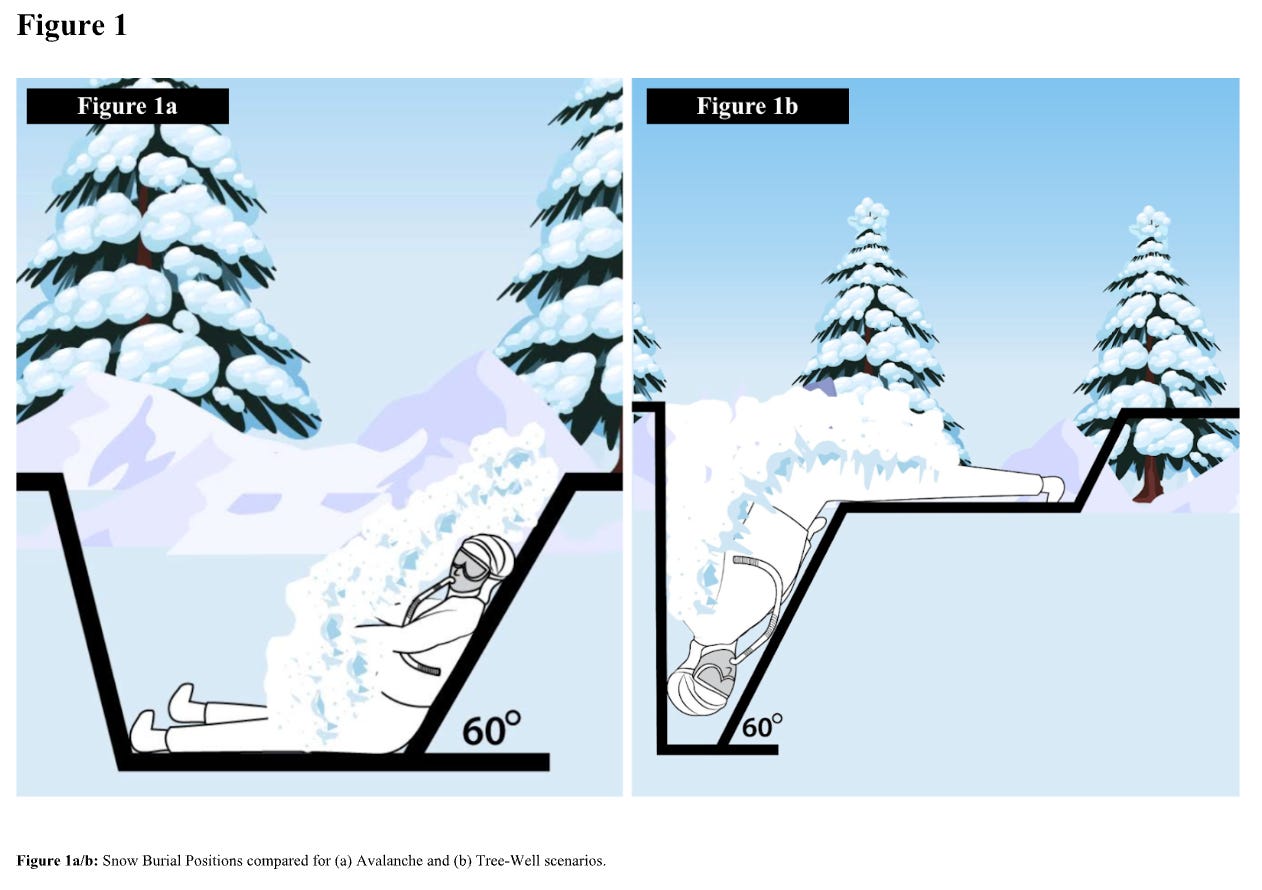
The experiment took place at a ski resort in Utah. For the avalanche scenario, researchers identified areas of untouched snow three feet deep and ten feet long. They then shoveled more snow over the area and compacted it by walking on top of it. The goal was to simulate the heavy snowpack in an avalanche, where snow density might be somewhere around 50 percent. A large pit was dug with a backrest of about 60 degrees and participants were laid down with their back and head reclined—and their body bent at the waist with their legs straight out. They wore an Avalung, a device which diverted expired air from going out around their mouths, to behind their back, to prevent a buildup of carbon dioxide around their face. They wore a contraption called a pulse oximeter on their index finger to measure oxygen in their blood, as a way to see whether they might be developing hypoxia, low oxygen in their tissues. They swallowed a capsule that measured their core temperature, to determine their rate of cooling, which could be used to see if they were likely to become hypothermic. A radio intercom was strapped to each participant’s chest. And the researchers added some other backup devices for safety. Then, the participants were buried with compacted snow—except for parts of their legs, so they could kick if they panicked.
The same devices were given to the participants in the tree well burial. (The subjects underwent each burial, three days apart.) But in the pit, the snow was not compacted. Lighter snow density often occurs in a tree well—somewhere around ten or twenty percent—and the researchers wanted to match that. A hole was dug with a 60-degree angle at the front of the pit, which the volunteers went down, head first, arms at their sides. Their bodies were bent at the waist. Then they were buried by snow, except for part of their legs, again, in case they panicked.
Eleven people agreed to be buried in both scenarios.
Which led me to ask a second question: “Who on Earth would volunteer to go through an hour buried alive in snow—twice?”
I called up study author Nicholas Kanaan.
The physician did his residency at Stanford in emergency medicine and then a fellowship in wilderness medicine at the University of Utah, focusing on high altitude medicine and snow and avalanche situations. Many of the available studies or write-ups on snow immersions, he notes, are just tallies. “We took it one step further,” he says, “in order to really drill down [on] what the physiology was and—on a minute-by-minute level—what was happening to these individuals.”
Two years prior to the study Kanaan was skiing in Tahoe during a week when it had snowed about ten feet. He jumped off a cliff into deep powder, and was buried, about three feet under the surface. “And that really stuck with me,” he says, “as how traumatic and uncomfortable and how quickly you panic in those situations.”
He wanted to learn more about what happened in snow burials, and this study was born.
But before he could put participants through the trial he imagined, he and a colleague decided to bury themselves first. When asked of his experience in the burial scenarios, he had an immediate, direct answer.
“It’s distressing,” he says. “It’s very distressing.”
“It’s cold. It’s dark. You can’t move,” he says. “You’re frozen in position and yeah, it’s 60 minutes dealing with our own physiology, breathing, and emotions.”
He only made it through 45 minutes of the tree well scenario, before quitting. And then made it through all 60 minutes of the avalanche scenario. He decided to move ahead. He posted about the upcoming study at ski areas, the University of Utah, and on listservs. He offered to pay participants $100 and give them a backcountry ski backpack.
And who agreed to do it?
“A lot of ski patrollers were really interested personally,” says Kanaan. “Because their job puts them at risk for being on both avalanche or non-avalanche snow immersions.”
They wanted to know what it would feel like and how they would perform. They could, in essence, test themselves in conditions where they had an out.
“Where we can flood the tube with oxygen if your oxygen is dipping down too low. We can pull you out if there’s any sign of issues,” says Kanaan. “It’s the perfect scenario for a terrible thing.”
In all, those eleven subjects participated. In the avalanche scenario, one person terminated early at 48 minutes. One person had their session terminated because their oxygen saturation dipped below 85 percent—at 55 minutes. And one person had their episode ended at 51 minutes because their core temperature went below 95 degrees Fahrenheit. Participants cooled faster in this burial scenario, likely because of the dense snow.
In the tree well burial, three people terminated their trial early—at 11, 14, and 19 minutes. All three cited anxiety and distress. The participants said the reasons for early termination were: “shortness of breath leading to panic,” “giving up because it was hard to breath[e],” and “anxiety leading to hyperventilation leading to dizziness.”
Roughly three-fourths of participants said the tree well burial was more challenging to tolerate. “There’s what the data shows, and then there’s the lived experience,” Kanaan says. “And people coming out were a lot more distraught after the [tree well] scenario.”
As an outside observer, it’s disturbing to imagine someone trapped, hanging upside down with blood rushing to their head, with their abdominal contents weighing on their diaphragm, having trouble breathing. In the tree well scenario, administrators terminated one subject’s experience due to low blood oxygen saturation—at 58 minutes. In that simulation, oxygen saturation decreased more than ten times faster on average than in the avalanche scenario.
Back at the beginning of the study, Kanaan hypothesized that the tree well simulated burial would result in more acute respiratory distress and hypoxia, even though the surrounding snowpack was less dense. He thought that right off the bat, because… “I haven’t been buried in an avalanche, but being upside down causes a lot of physiologic stress,” he says. “It’s hard to calm down and so I assumed there might be some hyperventilation that would happen in that type of scenario.”
His data supported his hunch, and showed a sobering physiological reality, even as he acknowledges the limitations of the study. “I recognize that not all avalanches result in someone in the seated position and not all tree wells involve someone upside down,” he says. “But it was really our best way of trying to approximate what happens in nature.”
Next, Kanaan would like to see more research on the correlation between inverted position, distress, and hypoxia. He says his study suggests that in a tree well scenario, responders should often focus on airways and breathing first, then focus on the heart (as folks can flip into arrythmias due to hypothermia), and then deal with exposure to the elements. (Trauma is often not associated with tree-well burials.)
But of course, before outdoor enthusiasts get into a situation where they need such care, they should take precautions to avoid danger or increase their chances for rescue in avalanches and tree well burials.
Baugher says of the latter situation, “If you really need to tell people in one minute what they need to know to be able to protect themselves from this particular mountain risk?”
“You gotta ski with a partner and keep your partner in sight,” he adds. “If you lose partner contact, you could lose your partner. It’s that simple.”
Several years ago, Baugher did a basic test—not in a peer reviewed journal—in which he buried ten people, five snowboarders and five skiers, upside down in tree wells with a time limit of two minutes. Only three people were able to extricate themselves, and that was mainly because they were in a position that allowed their bodies to bend 90 degrees at the waist. The rest of the participants quit the experiment well before hitting the full two minutes.
“The overwhelming number of snow immersion fatalities that I have in the database were found in the inverted position, and that has to do with how they went in and what it was like to try to get out,” says Baugher, later adding. “I call the inverted position the lethal position.”
He would like to see a device developed which could aid in rescues. This device might have GPS, a two-way radio, and an apparatus that signals when someone has stopped and is upside down. In those situations, a rescuer should do what they can to carefully—so they don’t put themselves in danger—dig towards the victim’s head from the side to provide an airway.
“You gotta get to your partner immediately,” Baugher says. “I mean, there’s no time to waste. These things? They have gone south in 10 minutes or less.”
And if you know anyone else who might like the Field and Lab newsletter, please share it.
Thanks for reading,
Joe
The first time I learned about tree wells, it was in the context of building a survival shelter. The article suggested that you position yourself near the tree and stomp down, creating a snow cave as you sink. You can break off the branches as you go, then use them to line the cave to insulate you from direct contact with the snow and to cover the opening for further protection. If you’re a skier, stand your skis in an X to attract rescuers’ attention.
Sounds good in theory, but after reading your article I would add the caveat that you should not dive in headfirst when making the cave.
Another winner! Passed it along to another nephew by marriage, Dr. David Johe.