

Science Journalist David Epstein Explains How Limits Can Help Us
His new book, Inside the Box, is packed with compelling stories of people and companies that benefited by having boundaries

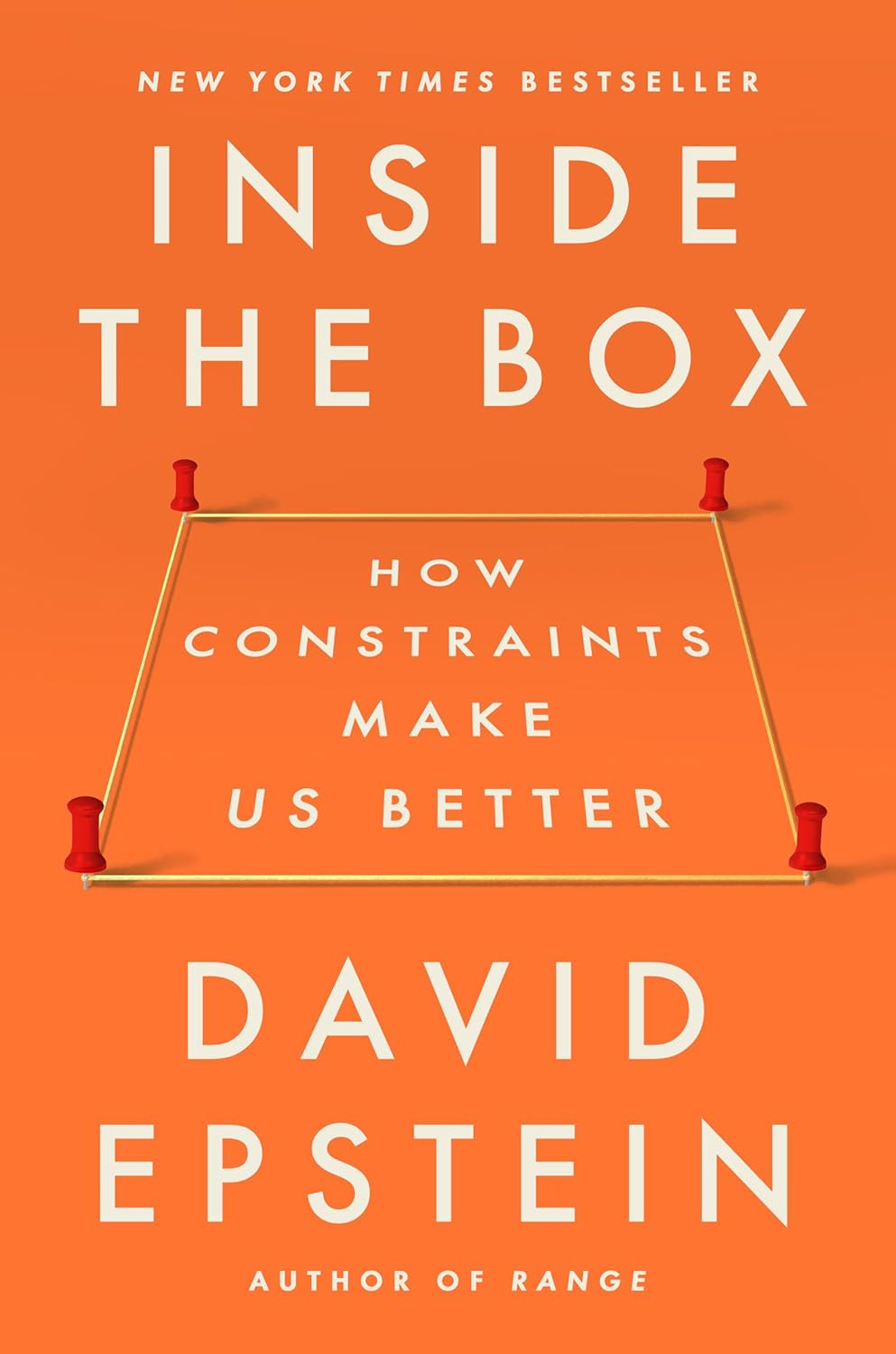
The idea seems counterintuitive. Giving ourselves constraints can free us up to be more productive and creative. But David Epstein makes just that case by detailing examples from science, art, sports, and more in his new book, Inside the Box: How Constraints Make Us Better. It’s a fascinating read packed with compelling stories of individuals and groups that found success after they instituted limits or limits were placed upon them. Epstein highlights the examples of a famous jazz pianist, an Olympic swimmer, the creator of the periodic table, and a technology company with ambitious goals. Hidden in such stories are lessons readers can adopt to become more successful themselves.
Epstein is an accomplished science journalist who worked at Sports Illustrated and ProPublica. His first two books were The Sports Gene: Inside the Science of Extraordinary Athletic Performance and Range: Why Generalists Triumph in a Specialized World. Both books are excellent, and I put The Sports Gene on my lists of The 25 Best Science and Nature Books of the 21st Century and The 25 Best Sports and Adventure Books of the 21st Century. Inside the Box is an engrossing addition to his published work, and by far the best science book I’ve read this year. I called Epstein up to learn more about it, and our conversation is below.
So when did you first get the idea for this book?
Good question. I’m trying to triangulate it exactly. There was a seed for it when, all the way back in college, I took a class on East Asian literature and got interested in the history of haiku, and how it really became a powerful art form when the top few sentences of what were these hundreds or thousands of line long poems got lopped off and turned into an art form that caused people to use words in a completely new way.
But that wasn’t ever present in my mind. That was so many years ago. So it was more after Range, my previous book. Probably the most common question I would get from readers, and these are people who liked it, was something along the lines of, “Oh, you know, I’m really broadly curious. I’ve done all this stuff, but I have trouble figuring out what to focus on.”
And I completely counted myself in that boat. I think there’s a reason why there’s been long spans between all of my books. It’s because I’m interested in a ton of stuff. I have difficulty putting boundaries around a project, to get going, and to bring it to completion. I mean, for my first two books, I wrote 150 percent the length of a book and then had to cut back to get a book because I really didn’t put good boundaries around the project. And so when I really started thinking of it as a topic that I might take on? That was, basically in the aftermath of Range from getting these questions from people and realizing that I had the same questions. I also needed to do a much better job of putting boundaries around my own projects if I was ever going to be a little more efficient.
I have a question about limiting yourself when you wrote the book. But before we get into that, I wanted to just talk about one of the constraints you mentioned in the book, which is the scientific method. You explain how it compels people to stop, think, and test. Most people might not associate the scientific method, which sounds kind of rigid and limiting, with productivity and creativity. But how does the scientific method free people up to be more productive or creative?
It’s actually a structured method for being curious, and not just being curious, but learning from your curiosity. I think one of the most important things is making a specific guess ahead of time, right? The scientific method involves making a hypothesis. And when you say hypothesis, it does sound kind of dry, but this can be in anything that you’re doing. If you’re a painter, it can be trying some new technique, making a prediction about what you think that’s going to do, and then trying it. And the thing about the scientific method is that it heightens the learning that you get from any particular experiment because you said what you expected ahead of time. You then did the experiment. And you then have something to reflect back on—did this fit what I was going for or did it not? And that drives you to the next experiment.
And so that’s why I wanted to cite not just scientific research, but that research in that chapter about entrepreneurs who were coached in the scientific method. And a main result was that they ended up realizing that their initial ideas were wrong more often than other entrepreneurs who were just trained in standard market research. And so that learning that you’re wrong and then reorienting is super important. I think we all don’t define what it is we’re going for, or what it is that we’re going to change ahead of time, then do the experiment. And not to say that there isn’t room for just free play completely, but I actually think this makes the free play even more valuable. Where you stake out a case, say what the experiment is, and doing that up front really increases the amount that you can learn from the experiment and should lead to the next experiment.
Earlier you brought up writing the book. Were there constraints you put on yourself when you were doing the reporting?
Yeah. One of the challenges that I had with previous books was I really have a tendency to go way down rabbit holes that may not be that relevant or useful when I come up for air. And I had already read before I was thinking about this as a book project some research on what is called specific curiosity, which is somewhat similar to what I just mentioned, the scientific method. It’s picking a specific question that you’re investigating, and just having a foothold often leads to better ideas through what researchers call idea linking, where you sort of jump from one rock to another. I really tried this time around to have a specific question before I was approaching a research trip, before I was approaching a researcher. And it was always one specific question. And that didn’t mean that interviews and research trips didn’t go in unexpected directions, because that happened almost every single time. But it helped me stay a lot more contained, where I put more forethought into what is the question I want addressed here. I’m not asking about what the answer is, but what is this specific curiosity here? I still went down rabbit holes, but I think more of those rabbit holes ended up being useful because I had a bit more of a view of what question I was trying to answer. Whereas in the past, any shiny thing that I thought was interesting? I would start chasing it and maybe two weeks later I would come up and say, “That’s ridiculous. How did I ever think that that was going to be a part of this project?”
And what was the biggest limitation that you put on yourself in terms of writing the book?
I started writing the book much later in the process this time around. In the past, I wanted to get a jump on things. So I would start writing as soon as I thought I had enough reporting to start one chapter. I would just start whatever chapter that was. This time around, I did my reporting. And I compiled it into this thing—it’s a lame title—I called the “master thought list.” And it’s just a 100,000-word document.
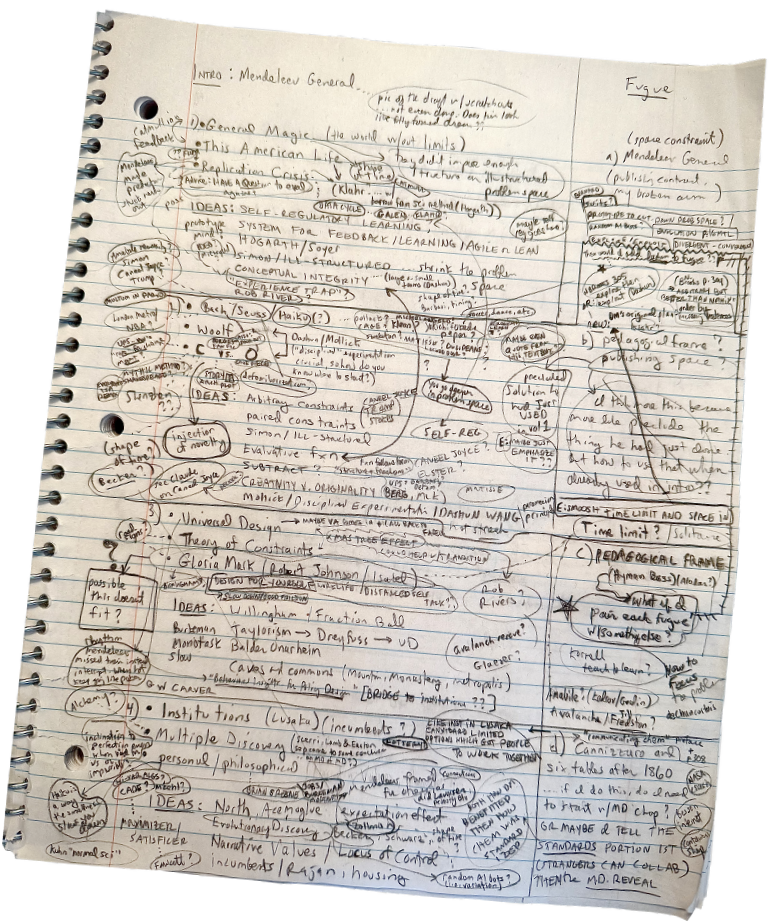
Of course, I can’t hold all that in my head. And I went to a hermitage at a Franciscan monastery and didn’t open my mouth for two days and just read it. And when I was done with that, I forced myself to outline it on one page and one page only.
Oh, wow.
There’s lines and bubbles all over the place because it’s a structure that I’m trying to get at. And it forced me to prioritize ruthlessly. So it’s 100,000 words down to one page of ideas. And if it’s not on that page, basically it’s not in the book. And there are even probably a few things on the page that I end up cutting out. But that was so helpful for me because it meant that a lot of things that I think are interesting were out. But the things that I thought were the most interesting were there. And so just that exercise of forcing me to clarify priorities was so useful in launching the process ahead. And again, I overwrote by like 50 percent my first two books. This one I turned in at the prescribed length, and early, which I didn’t even know was a thing with books. My first book I turned in a year after the original deadline. The second one I turned in at 5 p.m. on the day it was due. And this one I was sitting on because I finished early, even though I started writing late. And I think that’s in large part because I took more time to define the box, so to speak. When I did start writing, I knew the ideas that I was going after. And it gave me a lot more freedom to experiment with the writing inside that. So I actually enjoyed the writing more than I had in the past because I kind of felt like I knew the sandbox that I had to play in. And so my execution was so much faster, even though I started later.
One of my favorite parts of the book is when you talk about the process of the novelist Isabel Allende, who begins writing a new book every year on January 8th [if she’s not still working on another book]. You explain how that date is connected to her family. It’s this date when she started writing a long letter to her dying grandfather. I know that example speaks to the value of routine and to the value of limiting disturbances. But do you think it also works so well for her because it’s tied to such an intimate moment in her life?
Probably, probably. It makes sense to me that that would give it a value and a gravity, above and beyond what it would if she just randomly decided. And I think it can be important but hard when you set up rituals to make them feel real. I mean, obviously they’re institutions that have done a great job at that, like religions or all sorts of institutions. I think when it’s just you, that’s a lot more difficult. One of the reasons why people have trouble with behavior changes is because it’s hard to make the kind of ritual or habits that you’re going for feel like a real thing that’s part of your life and your identity. And so, I don’t have any research to back this up, but it makes a lot of sense to me that when you’re trying to make this feel like a real deadline, that having some connection to something really personally meaningful would give it that visceral feeling of realness.
And by the way, maybe a little bit to your point for how real it feels. Isabel sent me… this is just a little funny. I offered to send her an advance copy of the book, in early February. And she said, “Yes, please send it, but as you know, I just started another novel,” because it was shortly after January 8th, “so I won’t be able to read it.”
Perfectly on brand. Then she sends me another email, maybe a month or two later. Do you want me to pull this up and read it to you?
Yeah, that’d be awesome.
So she sends me this note saying that she’s reading it and she’s loving it. I’m like, “Well, that’s great. I’m so glad you’re enjoying it, but why are you reading it? You’re supposed to be writing a novel.”
And she says,
I started a novel on January 8th, and gave myself a deadline to finish a first manuscript by the end of March. The reason is not important. My agent, my brother, read it and liked it a lot. It still needs polishing, but it’s May, and I find myself without work until next January 8th.
So she takes this very seriously.
I’m going crazy. I’m getting rid of my clothes. Replacing the furniture, walking in circles, reading compulsively, etc. Your book has been an inspiration. I need to give myself a task with boundaries. For example, write a novel set in Lima in the year 1610 about a cowardly Spanish soldier, an Inca maid, and the Inquisition. Or a story set in 1810 in Ireland about a girl/witch expelled from her village who seeks revenge. You get the idea. I can’t start writing until January 8th, but I can start researching and planning. I have total freedom to do whatever I want, and at my age, 84, I have no obligation to keep writing. This freedom is lethal.
Help!!!
Love,
Your Pen Pal
And then like an hour later, she writes,
Do you have an idea for me? Not the Inca maid or the Irish witch.
I thought it was so funny. She’s obviously struggling with that freedom and yet she is not willing to start before January 8th. She can research, but I think it just testifies to how real that deadline is for her, that she knows she’s having a problem and it’s sacred. I don’t know if it would be sacred if it didn’t have that family connection.
That’s really cool, because it’s also a situation where a source you had for the book and learned from actually benefits from what you’ve created.
Yeah, I hope so. Of course, as you might imagine, I started sending her ideas. Because how cool would it be if she writes her next novel from an idea I gave her. I’m holding my breath. No expectations, but it would be awesome.
Yeah. One of the other things I like about the book is that you talk about these big creative advancements throughout history, the periodic table, the theory of evolution, even the formation of Pixar, but then you also bring things down to a personal level. And one thing you talk about is the way you manage distractions and prevent multitasking from taking up space in your brain by not looking at email first thing each day. Since you’ve written the book, are there bits readers have said helped them to be more productive and creative in personal ways?
Probably the most feedback I’ve gotten from leaders about their personal productivity has often been less about that multitasking part of the book, and more about two other parts. One, the theory of constraints, this idea that a single bottleneck or least efficient step in your process limits the overall system. And often people have come up to me and said, “You know, this made me think about some aspect of my work that really is the limiting factor.” And sometimes that is their attention, and that can lead to them thinking about multitasking.
The other has been the stuff at the end about satisficing and not trying to make perfect decisions. Just getting to good enough and moving on. And so I wasn’t even really thinking about that as productivity advice, [but] more as personal contentment and sanity advice. But that’s an area that people have mentioned to me a lot.
I’ve talked about some of the multitasking stuff because that was, probably the biggest thing that I applied to myself. I wrote a newsletter where I mentioned that Ernest Hemingway would stop in the middle of his writing days supposedly in the middle of a sentence. I know he said that he would stop when he knew what the next idea was. I actually read the interview where he said that. In terms of actually stopping in the middle of a sentence? I haven’t seen it from him verbatim, but that’s allegedly what he did. In the newsletter, I called this “The Hemingway Principle,” where the last thing you should do in each workday is write down the important thing that you will start the next day with.
And then start with that because it protects against two things. One is just the drift to feeds that you will passively go to, and start the day with multitasking if you haven’t already picked the important thing you’re going to do. And two, this thing called the “mere urgency” effect, which is related. This is this psychological finding that people will prioritize tasks that feel urgent over ones that are important, even if the important ones are an objectively better use of time. And so that will be things like answering emails just because they feel urgent, even if they’re not important.
And that seemed to really resonate with people. I got a bunch of feedback on it. And so I think that act of designating where you’re going to start your day, as a little bit of a protection against immediately multitasking, is potentially powerful.
You mentioned Hemingway. You’ve talked a little bit about how you limited yourself in writing the book. In terms of tips for other writers out there, either of newsletters or features, what advice would you give so people don’t go so far over their word counts?
When I used to write for Sports Illustrated, if the shortest length of a feature that you would have would be 1500 words, I learned pretty quickly that 1500 words meant three sections. And that made it so much easier for me. Once I understood that that length means it’s going to be an opening with a scene in the present, then giving the background, and then coming back to the present and maybe foreshadowing the future.
And so thinking in sections. I’m a big outliner before I write. And I think if you’re given a word count, instead of thinking about everything you want to pack in, instead of thinking about 2500 words, [ask] “Is this four sections? Is this five sections? How many ideas do I really want to get in here?” Because I think the smaller the chunk you’re dealing with, the easier it is to plan. And so I would try to, before you start writing, do a little bit of outlining and just think about what are those sections and how many words are in each section. And if you’re just writing to the word length of a section, I think you’re a lot more likely to keep it under control.
That’s good advice. You also talk about discoveries in the book and how many big ones are evolutionary, not revolutionary. How can people apply that to their own lives or work?
One, not having the idea that they’re just going to be struck by inspiration, right? It doesn’t mean there aren’t moments of insight, of course, but so many of these even world changing breakthroughs came from someone that was working on a specific, well-defined…what seemed like a much smaller problem.
I mean, Einstein, getting to special relativity, was working on this well-known problem. When you move a wire and a magnet past each other, you get an electrical current, and the physics look different depending if you’re moving the wire or the magnet and he didn’t like that. So even arguably the most mind-boggling idea humans have ever come up with, started with finding this much smaller, well-defined problem.
And so, we don’t put enough time into problem definition. I think that’s increasingly true with AI, where I’ve been around it. I spent some time with an AI company that helps other companies implement AI. And it has given me some insight into why we’ve had insane numbers for adoption and much less impressive numbers for productivity growth. In fact, some cases arguably almost nothing. A lot of these companies are doing this like sprawling implementation where they’re like, “Oh, here’s this tool. We can do so much stuff.”
It’s leading them to skip over the hard work of figuring out what’s not worth doing. And so you just get what some researchers are now calling “work slop,” like this incredible volume of stuff. So I think it’s just never been easier to do too much. And the companies that I’ve seen that have done better have really defined the problems they’re trying to solve and then said, “Well, what problem does this tool fit?” Or one company created what they called a “map of jobs” to be done throughout their organization and then said, “All right, well, which of these are a fit for these tools?” And they were much more successful with implementation.
So that’s just an analogy for individuals, on taking a little extra time to define the problem you think you’re solving. There’s this saying, I don’t know, who came up with it, but that, “People don’t want a quarter inch drill. They want a quarter inch hole in the wall.” So not thinking about what it is that you’re trying to make or do, but what is the problem that you’re trying to solve. Or Tony Fadell, one of the characters in the book, convinced me to write a press release for my book before I wrote the book. He was one of the first people I interviewed. He said that’s going to force you to think about what problem you’re trying to solve and who you’re trying to reach. And so maybe I’m getting a little far away from the evolutionary revolutionary, but I think the fact is that huge breakthroughs often come from people starting with smaller, well-defined problems, and then progressing step by step.
And so the thing that individuals can take is this idea that they should spend a little extra time in defining for themselves, as rigorously as they can, the problem that the work they’re doing is solving.
Throughout this book, there’s just so much helpful information you have for readers, and you talk about the value of good readers in the book. Since the publication of the book, what’s the most notable thing you’ve learned or heard from a reader? It could be from your book or your Substack, where you have a ton of stuff about the book and the research you did for it.
The first thing that jumps to mind when you say that is a story that someone told me. I don’t know if that counts, but I think it does. So one of the readers was a guy named Ed Hoffman, who was the first chief knowledge officer at NASA, which is a position created after the second shuttle disaster was deemed a very similar cultural failing to the first one. So this was a position for someone who would make sure that the organization learned both from successes and failures—had institutional memory. And he said, “Oh, I want to tell you about this mission called LCROSS, where engineers ended up with half the time, and half the money that they would have liked. But instead of giving up on it, they took the approach of, ‘If we were going to get this done anyway, how would we get it done?’” And it led them to borrow technology. They took imaging equipment straight out of army tanks and engine temperature sensors straight out of NASCAR. And they created a probe that confirmed water on the moon.
I just loved that story because, first of all, if they had been given a quarter of the time and a quarter of the budget, could they still have done it? I don’t know. I think there is a line. But I just love that framing, because one of the things I was hoping for with the book was that it would be kind of an emotional reframe for people dealing with limits, seeing some of the power. I’m sure they were disappointed when they first found out what their budget and timeline would be. But then taking that approach of, “If we were going to get this done anyway, how would we do it?”
And so you have like two really good prompts in there. The first one is the path of least resistance is blocked. So the normal thing that they would have done is blocked. And the second is, “Okay, well, what can we come up with without that? What can we do differently?”
And I think anyone can ask that question. “If I couldn’t propose the same thing at this next client meeting or in this next pitch, what would I propose instead?”
And that’s one of the greatest creative prompts you can have—if the normal path is blocked. And so, of course, when Ed shared that story, it led me down this whole rabbit hole. I was an astronomy minor, so I’m interested in space in general. But it just led me down this path of researching other stories and I was just reading about one where the Indian Space Research Organisation, their NASA, sent a probe to Mars for significantly less than the budget of the film Gravity. And because they couldn’t just load it up with as much fuel, as much power as NASA does, they had to come up with this way to sort of circle it around the Earth several times, building up speed and then sling it off to Mars. It ended up being an incredibly cost-efficient probe to Mars. So yeah, people have been laying a lot of good stories on me, which I’ve really enjoyed.
You can share your own stories with David Epstein by following him on his Substack, Range Widely, or YouTube, and leaving notes in the comments.
If you read this post on the Substack site, an Amazon link to Inside the Box will appear here:
https://amzn.to/4fhRqJW
I make a very, very small amount if you click directly from the link and buy a book. But please don’t feel obliged to. If you don’t need delivery, ideally you’ll head to your local bookstore for the title. I know that’s my favorite way to shop for books.
And if you know anyone else who might like the Field and Lab newsletter, please share it.
Thanks for reading,
Joe
This interview has been edited for length and clarity.
As an Amazon Associate I earn from qualifying purchases.
Love this interview, Joe!